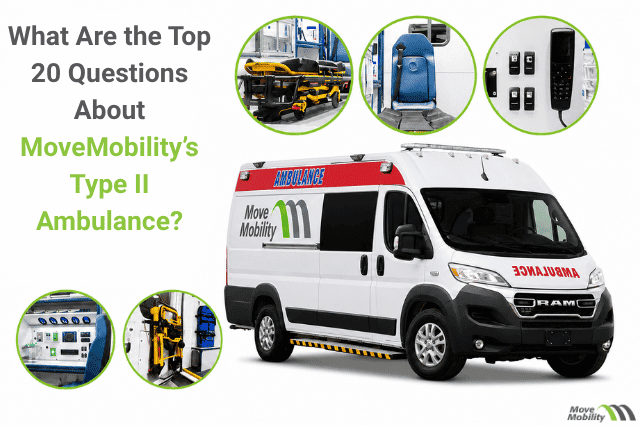
What questions should you ask before choosing a Type II ambulance for your EMS service in Canada? It’s a big decision, and it can feel like every choice carries weight. You’re thinking about crew safety, patient access, storage, daily workflow, and how the vehicle will hold up in real Canadian operations, like busy Ontario streets and remote community calls in Northern Canada. The wrong fit can cause your team to face cramped movement, slower loading, poor storage, or a layout that fights them every shift.
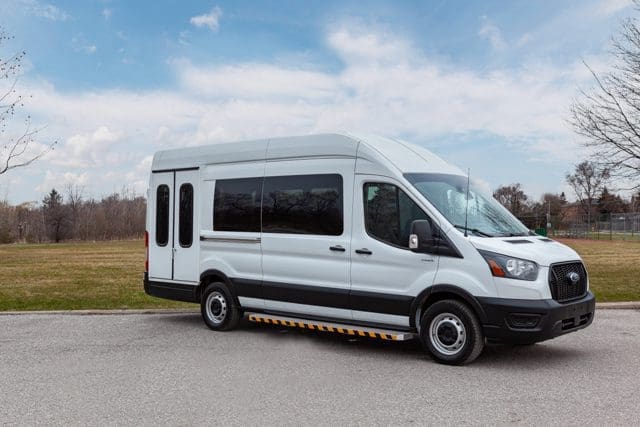
Au MoveMobilityNous avons dépensé plus de 20 ans building vehicles that help remove barriers to healthcare and transportation. We’re proud to introduce our new Canadian-built Type II ambulance, designed around patient transport, EMS workflow, safety, and day-to-day service needs. It’s built on the Ram ProMaster 3500 High Roof Extended platform and shaped by paramedic and frontline EMS experience.
In this article, you’ll learn the top 20 questions that might be on your mind about our new Type II ambulance.
20 questions about MoveMobility’s Type II ambulance
When you’re considering a Type II ambulance for your EMS team, the big questions usually come down to one thing: Will this vehicle help your crew do their job better, safer, and with less friction?
1. What is the ceiling height in MoveMobility’s Type II ambulance?
MoveMobility’s Type II ambulance has an interior standing height of 74 inches, or about 6.2 feet.
That gives most crew members more room to stand, move, reach equipment, and support the patient without feeling boxed in. During a long transfer from a rural hospital to a larger centre, that extra head clearance can make the patient compartment feel more workable.
This extra headroom helps your team focus on care instead of fighting the ceiling.
2. What vehicle platform is MoveMobility’s Type II ambulance built on?
MoveMobility’s Type II ambulance is built on the Ram ProMaster 3500 High Roof Extended platform.
It includes a 159-inch wheelbase, high roof body style, front-wheel drive, and an OEM integrated platform. The vehicle keeps the OEM suspension and ride quality during operation, which helps create a familiar driving experience for your team.
For Canadian EMS services, this platform can support a wide range of daily routes. Think urban calls in Ontario, regional transfers in Saskatchewan, or mixed-service use across smaller communities in Atlantic Canada.
The base vehicle includes:
- Engine: 3.6L V6 gasoline engine.
- Transmission: 9-speed automatic transmission.
- Drive: Front-wheel drive configuration.
- Safety support: All-Speed Traction Control and Electronic Stability Control.
- Visibilité : Backup camera, backup alarm, and power heated folding mirrors.
That gives your team a clear starting point when comparing a Type II ambulance for sale against other ambulance options.
3. How much patient compartment space does the Type II ambulance provide?
MoveMobility’s Type II ambulance is designed with 9.3% more cubic space compared to the Type III reference shown in our layout comparison. It also provides 53 square inches of additional usable floor space.
That’s important because usable space affects how your crew works. It’s not about having a big empty box. It’s about smart room for movement, equipment access, cot-side care, and patient support.
The patient compartment also uses an integrated all-aluminum construction and is built around EMS circulation. That means your crew can move through the space with a layout that feels familiar and practical during patient transport.
4. How does patient loading work in this Type II ambulance?
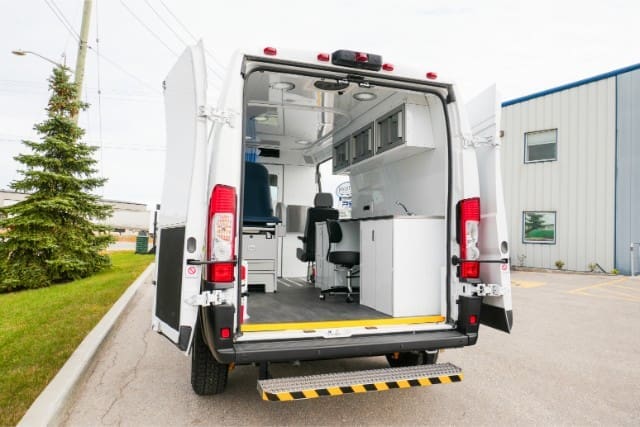
This Type II ambulance includes full-width rear loading access and rear doors with wide-opening access.
That helps your crew load and unload patients through the back of the vehicle in a way that feels familiar. We also include a rear offset flip-up step to support loading and unloading.
For example, if your team is transferring a patient from a long-term care facility in rural Manitoba, you want the loading to feel smooth and predictable. The last thing anyone needs is a poor access point, adding stress to an already sensitive moment.
The vehicle also includes a low OEM floor height for easier entry, which helps support smoother access for crew and equipment.
5. Can the patient compartment be accessed from the curbside?
Yes. MoveMobility’s Type II ambulance includes rear and curbside patient compartment access.
That means your crew can enter through the rear or the passenger-side sliding access door. This can help during calls where rear access may be tight, blocked, or less practical.
In a busy downtown hospital bay or a tighter clinic parking area, curbside access can give your team another way to move people, supplies, or equipment. That flexibility helps reduce delays and keeps your crew from doing the awkward ambulance shuffle. No one trains for that, thankfully.
The design also supports clear access and circulation for patient loading, crew movement, and equipment access inside the patient compartment.
6. What cot system is used in MoveMobility’s Type II ambulance?
MoveMobility’s Type II ambulance uses a single-cot patient transport configuration with an in-floor cot rail system.
The cot system includes a 95-inch floor plate length and is compatible with Stryker powered stretcher systems. It also includes a Stryker floor-mounted fastening system and integrated power provision for powered stretcher options.
That means the ambulance is built to support a familiar EMS loading workflow. Your crew shouldn’t have to relearn the basics every time they move a patient. The goal is to make the ambulance feel practical, steady, and built around the way EMS teams already work.
7. What seating layouts are available in this Type II ambulance?
MoveMobility’s Type II ambulance is available with two patient compartment layout options:
- Dual airway seats: This supports crew seating and airway access.
- Two-position bench: This supports different service needs and patient transport setups.
The ambulance also includes a rotating rear-facing attendant seat. That gives your team another seating position inside the patient compartment.
The right layout depends on how your service operates. A community EMS team in Northern Canada may think about long transfers and varied patient needs. A regional service in Southern Ontario may focus on speed, access, and crew positioning across frequent calls.
Either way, the layout should support your team, not make them work around it.
8. Can this Type II ambulance support more than one patient?
MoveMobility’s Type II ambulance is designed as a single-cot patient transport configuration, but the bench configuration can support a second patient secured on a spine board when required.
That gives EMS services added flexibility for certain transport situations. It does not turn the vehicle into a multi-cot ambulance, but it does offer support for a second patient in the specific bench configuration described.
This can be helpful for services that handle mixed patient transport needs, especially in communities where resources are stretched, and response planning has to be practical. Every inch of the layout has a job to do.
9. What safety and restraint features are included?
MoveMobility’s Type II ambulance includes several safety and restraint features designed for patient and crew support.
Inside the patient compartment, you’ll find:
- 3-point restraints: Complete 3-point restraint systems throughout.
- Child restraint support: Integrated child seat and ISOFIX restraint points.
- Adjustable restraints: Restraint systems that can be adjusted for use.
- Grab points: Safety-yellow grab handles and rails.
- Bench support: Bench configuration that supports spine board securement.
The base vehicle also includes advanced front and side curtain airbags, Electronic Stability Control, All-Speed Traction Control, a backup camera, and a backup alarm.
For EMS teams, these features matter because safety has to support both sides of the call: the patient receiving care and the crew delivering it.
10. What storage is built into the Type II ambulance?
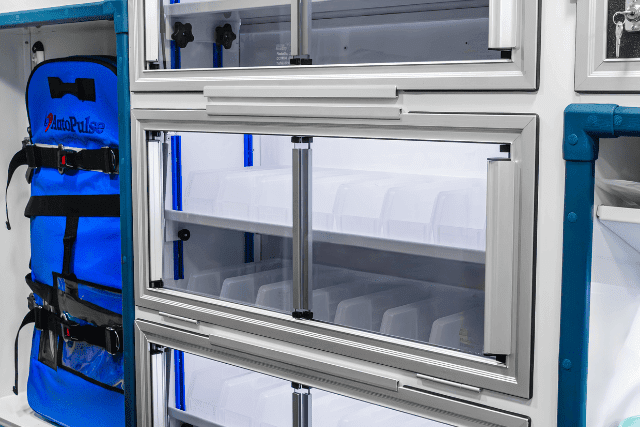
MoveMobility’s Type II ambulance includes storage for equipment, oxygen, medical supplies, and personal items.
The patient compartment includes ample equipment and personal storage, rear stair chair and glovebox storage, safety bag and backboard storage, and partition storage for medical equipment.
For oxygen and medical access, it includes:
- Oxygen storage: Sliding oxygen storage track system.
- Cylinder space: M-cylinder oxygen storage compartment.
- Suction access: Integrated suction access.
- Action wall access: Access to oxygen and controls.
The driver area also includes personal storage compartments with restraints, multiple cup holders, dual coat hooks, and adjustable centre console controls.
That may sound simple, but organized storage can reduce wasted motion. When your crew knows where things are, they can move faster and with more confidence. That’s the kind of gap a strong layout can help close.
11. Is MoveMobility’s Type II ambulance built for Canadian ambulance requirements?
Yes. MoveMobility’s Type II ambulance is built in Canada by a 100% Canadian-owned, Ontario-certified Type II ambulance manufacturer. The conversion is designed to comply with Transport Canada regulations, applicable Canadian Motor Vehicle Safety Standards, and completed vehicle certification under National Safety Mark requirements.
For Canadian EMS teams, that’s a big point. You’re not buying a vehicle that has to be “made to fit” after the fact. You’re looking at an ambulance designed for Canadian operation from the start.
That can help your team feel more confident during procurement, fleet review, and internal approval conversations. Nobody wants to spend six meetings trying to decode compliance details. Well, nobody we’ve met, at least.
12. What kind of EMS operations can use this Type II ambulance?
MoveMobility’s Type II ambulance is designed for several types of EMS operations, including:
- Urban service
- Regional service
- Mixed-service operations
- Interfacility transport
- Community EMS programs
That range is helpful because no two Canadian services operate the same way. A team in Vancouver may deal with tight streets and frequent facility access. A service in rural Alberta may focus more on longer transfers and varied road conditions. A community EMS program in Northern Canada may need flexibility for different call types.
This ambulance Type II is built to support patient transport, EMS workflow, and day-to-day service operations across those kinds of environments.
13. What are the exterior dimensions of MoveMobility’s Type II ambulance?
The Type II ambulance has an overall length of 251 inches. It has an overall width of 98 inches with mirrors and 81 inches without mirrors.
It also has a turning diameter of 39 feet.
That’s useful when you’re thinking about real-world access. Your ambulance has to fit into hospital bays, clinic parking lots, community health centres, and tight residential streets. Some calls have plenty of room. Others feel like someone built the parking lot with a grudge against turning radius.
The compact exterior footprint helps support access while still giving the patient compartment room for crew movement and care.
14. What is the payload capacity of this Type II ambulance?
The ambulance has a payload capacity of over 2,300 pounds.
Payload is one of those details that can get overlooked early in the buying process. Then the vehicle enters service, and suddenly every piece of equipment, supply bag, oxygen cylinder, and patient transport need becomes part of the conversation.
This capacity helps support the equipment and operational needs of EMS teams while keeping the conversion designed to preserve payload capacity. That’s important for services that need a practical balance between patient care space, installed systems, and real daily use.
15. What does the driver’s compartment include?
The driver compartment keeps the OEM cockpit spacing and is designed to support comfort, visibility, and daily use.
It includes:
- Storage: Personal storage compartments with restraints.
- Confort : Dual coat hooks and multiple cup holders.
- Contrôles : Adjustable centre console controls.
- Communication: A communication window to the patient compartment.
- Visibilité : Open forward visibility.
For your crew, the front cab is their workspace too. It’s where they drive, communicate, navigate, and manage long shifts. A clean and familiar driver area can make the day feel less chaotic, especially during back-to-back calls.
16. What HVAC system is included in this ambulance?
This ambulance includes a dedicated patient compartment HVAC system with fully controllable heating and cooling. It also includes an integrated ventilation system.
That’s important in Canada because weather doesn’t politely stay in one lane. Your service may face humid summer days in Ontario, dry prairie heat in Saskatchewan, coastal weather in Nova Scotia, or freezing winter mornings in Manitoba.
The patient compartment is designed for EMS operational environments, so your crew can manage heating, cooling, and ventilation during patient transport. Comfort helps patients feel cared for. It also helps crews stay focused during long shifts.
17. What electrical system does MoveMobility’s Type II ambulance include?
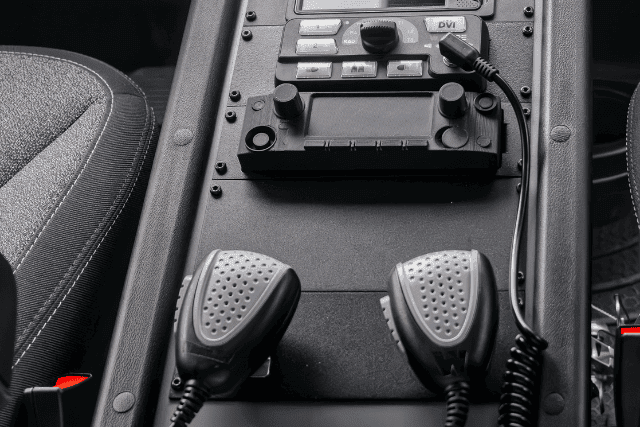
MoveMobility’s Type II ambulance includes an integrated electrical system designed to support EMS equipment and patient compartment use.
Key electrical features include:
- Power: 1000W inverter.
- Outlets: 120V power outlets.
- Chargement : USB charging outlets.
- Contrôles : Integrated patient compartment controls.
- Access: Accessible electrical service panels.
- Communication support: Integrated radio speakers.
This gives your team power access inside the patient compartment for daily operation. It also supports serviceability through accessible electrical panels, which can help when your team needs maintenance access without turning a small issue into a scavenger hunt.
18. What lighting is included in the patient compartment?

The Type II ambulance includes LED patient compartment lighting, a full-length reading light in the action wall, and eight dome lights with dual-bank operation.
It also includes high and low lighting modes, plus patient compartment task lighting.
Lighting can make a real difference during care. Your crew may need bright light while checking equipment or supporting a patient. They may also need lower lighting during a calm transfer or when patient comfort is the priority.
This setup gives your team flexible lighting inside the patient compartment, which helps support different care moments throughout the day.
19. Does this Type II ambulance include emergency lighting and siren systems?
Yes. MoveMobility’s Type II ambulance includes integrated emergency lighting and siren systems.
It also includes a backup camera, backup alarm, power heated folding mirrors, cruise control, All-Speed Traction Control, and Electronic Stability Control as part of the vehicle features.
For Canadian EMS teams, these systems support visibility, awareness, and safer vehicle operation. This is especially helpful when your team is moving through traffic, backing into a facility area, or driving in poor weather.
The goal is simple: give your crew the tools they need to operate with confidence before, during, and after the call.
20. What privacy and patient comfort features are included?

The ambulance includes tinted windows with rear door privacy tint. It also includes a full standing-height patient compartment, controllable HVAC, LED lighting, USB charging access, and seating layouts designed around EMS service needs.
These details may seem small on paper, but they can shape the patient experience. A person being transported may feel vulnerable, tired, anxious, or unsure of what comes next. Privacy tint can help protect dignity. Better lighting and climate control can help make the ride feel more controlled and less clinical.
That’s where a strong Type II ambulance should do more than move people from point A to point B. It should support the people inside it, including the patient and the crew caring for them.
Got any more questions about the Type II ambulance?
You came to this article because choosing a Type II ambulance is a serious decision. You’re trying to protect your crew, support your patients, meet Canadian service requirements, and avoid buying a vehicle that creates more problems than it solves.
After walking through the top 20 questions, you now have a clearer picture of how MoveMobility’s Type II ambulance supports real EMS work, including:
- Crew workflow: Standing height, cot-side access, curbside entry, and familiar EMS movement.
- Patient care: Restraints, privacy, HVAC, lighting, and a single-cot transport layout.
- Daily operations: Storage, electrical access, payload capacity, emergency systems, and Canadian compliance.
Au MoveMobility, we build vehicles for teams that carry heavy responsibility every day. Our work is shaped by real transportation, healthcare, and emergency service challenges across Canada. We understand that an ambulance purchase has to serve your crew today, your community tomorrow, and your budget long after the ribbon-cutting photos are done. That’s why we focus on practical design, clear communication, and vehicles that help remove barriers when people are counting on you. If you have questions, click the button below to talk to an ambulance expert.
Si vous n’êtes pas encore prêt à discuter avec un expert en mobilité, nous avons quelques autres ressources que vous devriez consulter pour en savoir plus.
Que devriez-vous lire ensuite ?
- Quels critères devriez-vous prendre en considération avant de choisir un type d’ambulance ? This is the best next step if you’re still comparing Type I, Type II, and Type III ambulances before making a final direction.
- Quel type d’ambulance est le meilleur pour une intervention urbaine ? This helps teams in cities and high-traffic communities think through access, size, workflow, and response conditions.
- Quels sont les trois types d’ambulances ? Learn all about the three different types of ambulances so you can further compare which one works for your organization.


 English
  French