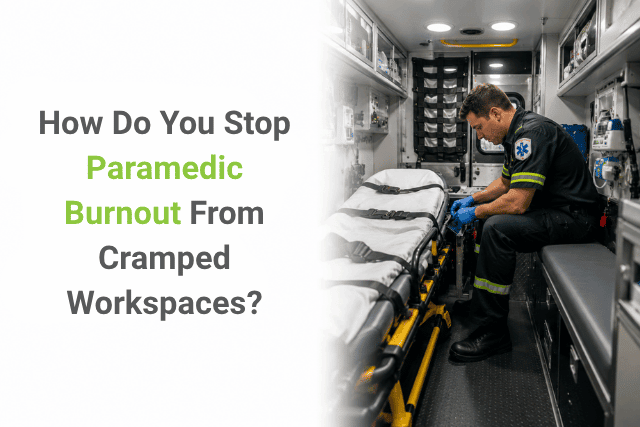
Did you know that almost 60% of first responders are likely experiencing high levels of paramedic burnout? It’s a heavy weight to carry when you’re trying to save lives in a space that feels like a tiny hallway. You see your team coming back from shifts in places like snowy Winnipeg or busy Vancouver, looking totally drained. They’re sore from bending over in tight spots all day. They feel frustrated because they can’t move freely to reach their gear.
If you don’t fix this gap in their workspace, your best paramedics might leave the job forever. This high burnout rate for paramedics means your community loses its most experienced helpers. You want a team that feels strong and respected. Imagine a workspace that actually gives them room to breathe. This change closes the gap between a painful shift and a great career.
At MoveMobility, we’ve spent over 20 years learning how to make these spaces feel right. We’ve built more than 150 mobile medical units to help communities across Canada. We’ve even partnered with amazing groups like Keewatinohk Inniniw Minoayawin to improve local health outcomes. We know there are other builders out there, so we just want to share what we’ve learned. Burnout in paramedics is a serious issue that we’ve seen across the country.
This article will help you understand:
- What is paramedic burnout?
- How do you stop paramedic burnout?
What is paramedic burnout?
It’s a lot more than just feeling tired after a long day of work. Paramedic burnout is that heavy feeling where you wake up and your heart feels like lead before you even put on your uniform.
You might feel like you’ve got nothing left to give to the people who need you. It’s that moment in the middle of a shift in a rainy city like Vancouver where you realize you’re just going through the motions. You care about your patients, but you feel totally disconnected from the joy the job once brought you. This isn’t your fault. It’s what happens when the stress of the job stays with you long after you go home to your family.
The burnout rate for paramedics across our country shows us how big this problem really is. Recent reports show that nearly half of Canadian workers feel burned out. For your team on the front lines, it’s often even higher. In places like Winnipeg, a recent survey found that 78 per cent of paramedics feel emotionally drained. When your crew feels this way, they feel like they’re hitting a wall every single day.
- Emotional exhaustion: This is when you feel like your battery is at zero and won’t recharge.
- Feeling detached: You might start to feel like the people you help are just numbers instead of neighbours.
- Physical pain: Cramped vans and heavy lifting make your body hurt as much as your mind.
Why is the paramedic burnout rate climbing in Canada?
We see the impact of this struggle in every province. In Toronto, the service has been losing about one person per week because the stress is just too high. When your team members leave, it puts even more pressure on the people who stay. This creates a cycle where the paramedic burnout rate just keeps going up. It’s hard to keep a smile on your face when you’re working in a space that’s too small for you to move comfortably.
Think about a paramedic in rural Alberta. They might be working 14-hour shifts with no real breaks. If they’re spending all that time in a vehicle that feels like a tiny box, their stress levels skyrocket. Burnout in paramedics often starts with these small physical frustrations that build up over time. When you can’t stand up straight or reach your tools easily, you feel like the world is closing in on you.
- Lack of space: Working in a tight van makes every task feel ten times harder.
- Long wait times: Sitting in hospital hallways for hours adds to the mental weight.
- High call volume: Racing from one emergency to the next without a second to breathe is draining.
It’s important to recognize that burnout in paramedics doesn’t happen because your team isn’t strong enough. These people are heroes. The problem is usually the environment they work in every day. If their workspace doesn’t support their health and dignity, they can’t provide the best care. We want to help you see that changing the space can actually help change how your team feels about their life-saving work.
Now that we know what this problem looks like, let’s talk about how the space around your team might be making things worse.
How do you reduce paramedic burnout?
Helping your team starts with looking at where they spend their whole day. Imagine you’re a paramedic working a 12-hour shift in a place like Saskatoon or Ottawa. You’re constantly crouching over patients. You’re twisting your back to reach for bandages or oxygen. Your neck is always tilted at a weird angle because the ceiling is too low.
This constant physical strain is a major contributor to paramedic burnout. When your body hurts every single minute, your mind starts to feel the weight too. You can’t provide the best care when you’re distracted by a sharp pain in your spine.
You can stop paramedic burnout by giving your team a vehicle that actually fits their bodies. At MoveMobility, we designed our Type II ambulance to fix this exact problem. Most people don’t realize how much the height of a van matters. Our units have an interior standing height of 6’2 inches. This means even the taller members of your crew can finally stand up straight. Think about how good it feels to stretch your arms up high after being cramped in a chair. Now imagine your team being able to do that right inside the van between calls.
- Better posture: Standing tall helps take the pressure off the lower back and neck.
- Mental clarity: Taking a deep breath while standing straight helps clear the mind during a crisis.
- Easier movement: A taller ceiling means your team can move from the front to the back without bumping their heads.
Why is space part of the key to reducing burnout in paramedics?
It’s not just about the inches on a tape measure. It’s about how the space makes your team feel. When a workspace is cramped, it feels like the walls are closing in on you. This contributes to the high paramedic burnout rate because it adds extra stress to an already hard job. In a MoveMobility van, the interior feels much bigger than it looks from the outside. We use a smart layout that keeps everything your team needs within reach without cluttering their floor space.
Imagine a paramedic named Dave, 6’1, working a busy night in downtown Toronto. In his old Type II ambulance, he had to squeeze past his partner with his head tilted over just to get a fresh pair of gloves. He felt trapped and frustrated. Now, imagine Dave in a van where he can stand up straight to adjust his gear without asking anyone to move. This sense of freedom is a powerful tool against burnout in paramedics. It gives them back their dignity. It shows them that their comfort matters to your organization.
- Reduced frustration: Not having to fight with a cramped layout makes the day go more smoothly
.
- Improved safety: A tidy and spacious van reduces the risk of trips or falls during a move.
- Focused care: When paramedics aren’t worried about their own pain, they can focus entirely on the patient.
Closing the gap to lower the burnout rate for paramedics

When you choose a vehicle with a better layout and more headroom, you’re closing a gap in your team’s health. The gap is the difference between an employee who feels like a sardine in a can and one who feels like a valued professional. This is how you lower the burnout rate for paramedics in your local service. You’re giving them a home base that supports them instead of working against them.
The table below shows how a simple change in height and space can change the workday for your crew.
| Feature | Old cramped Type II ambulance | MoveMobility Type II |
| Standing height | Usually under 6 feet | 6’2 inches tall |
| Physical feel | Tight and claustrophobic | Open and airy |
| Body impact | Back and neck pain | Ability to stand up |
| Mental impact | High stress and frustration | Calm and empowered |
Small things add up to big results. A van that lets a paramedic stand tall is a van that helps them stay in the job longer. It’s an investment in their future and the health of your community. When your team feels respected by the equipment they use, they’re much more likely to keep showing up with a smile. It turns a “just okay” job into a career they love.
Ready to stop paramedic burnout?

It’s hard to watch your team struggle with the physical and mental weight of paramedic burnout every day. You probably landed on this article because you want to fix the gap between a stressful job and a career that feels rewarding and safe.
If you’ve made it this far, you now have a few more ideas about how you can reduce burnout in paramedics.
Our team at MoveMobility has spent over two decades listening to the stories of first responders and medical teams from the Maritimes to the Yukon. We create spaces that empower people to do their best work without feeling physical pain. We’re a proud partner for healthcare leaders across Canada. We truly care about the lives being saved inside our vans. If you have any questions at all, click the button below to talk to an ambulance expert today.
If you aren’t ready to talk to an ambulance expert quite yet, we have a few other resources you should check out to learn more.
Recommended next reads
- What are the three different types of ambulances? This article helps you learn about the different types of ambulances so you can find the best fit for your team.
- What should you consider before choosing an ambulance type? Read this to see which factors matter most when you’re trying to pick an ambulance for your team.
- Which ambulance type is best for urban response? This guide is perfect if you work in a crowded city and need a vehicle that is easy to drive in traffic.

 English
  French