In Toronto, the City Auditor General found that ambulance response time targets were met about 80% of the time in 2023, and for the most urgent CTAS 1 calls, dispatch targets were met only 56% of the time. That’s the reality behind today’s emergency response times in dense Canadian cities.
If you’re running an EMS organization, you track your average emergency response time closely. You review emergency services response times. You explain the average response time for emergency services to your board. And you might be wondering something tough. Is the size of your ambulance quietly adding minutes?

Think about downtown Montréal. Delivery trucks double-parked. Condo towers in Toronto with tight access lanes. Snow-packed streets in Winnipeg that shrink turning space. Larger units can struggle in those conditions.
- Turning radius matters.
- Clearance matters.
- Parking matters.
When response times for emergency services lengthen, public trust and patient outcomes suffer.
At MoveMobility, we’ve supported Canadian health teams for over 20 years. We’re certified under Ford Pro Upfitter and Stellantis QPro, and our vehicles carry the National Safety Mark. We’re also proud to be finalizing our new Type 2 ambulance platform. Click the button below to learn more about that.
In this article, you’ll learn:
- What emergency response times look like across Canada
- How vehicle size can affect emergency services response times
- If a Type 2 ambulance can help close that gap
What do emergency response times look like across Canada?
When you look at emergency response times across Canadian cities, the picture isn’t simple numbers you can check off a list. What is clear is this: many services are under pressure, and performance varies from city to city. For EMS leaders, that means you’re juggling targets, big crowds, and city layouts that don’t always make it easy to be fast.
There isn’t one national report that covers every city, but the local stats and reporting that do exist show real challenges for response times for emergency services across the country.

Here’s what we know from recent data:
| City/region | What the numbers tell us |
| Montréal region (varied communities) | Best cases ~7.4 min, worst >15 min on highest-priority calls |
| Québec municipalities | In many areas, 45% of urgent calls took more than 10 minutes to arrive |
| BC Ambulance Service | Meeting targets is a shared challenge across most North American EMS systems due to demand, roads, weather, and traffic |
| Prince Edward Island | Ambulance response times are tracked regularly, showing variation over time |
| New Brunswick EMS standards | Urban calls aim for 9 min or less 90% of the time; rural calls are much longer |
| Manitoba | Actual 90th percentile response time: 15:52 (2024 actual) vs. target < 9 mins. |
| Nova Scotia | EMCI has not met the response-time performance standard for any month since the 2021 contract; example: July 2022 on-time only 69% (emergency) and 64% (urgent). |
How do you read these numbers?
These figures don’t come from some random blog. They come straight from regional services, government postings, and ambulance performance reports.
What they show is this:
- Cities are different: In some parts of Montréal, you might get an urgent ambulance in under eight minutes. In other parts, it can be closer to fifteen.
- Many urgent calls take longer than ideal: In Québec, close to half of urgent calls were over 10 minutes.
- Meeting targets is just hard: Even places with set goals (like 9 minutes 90% of the time) have a tough time hitting them across every call type.
- Rural vs urban: Response time strategies are very different in urban cores than in more remote communities, and that affects the numbers.
These stats matter because response time reflects a system’s ability to reach people when they’re at their most vulnerable. Long waits can add stress to your crew and anxiety for the community. As call volumes rise and city streets stay congested, you feel the gap between where you want response times to be and where they often are.
This isn’t a Canada-wide indictment of EMS; some regions do meet or exceed standards on certain calls, but the variation shows it’s far from easy to deliver fast, consistent emergency services response times everywhere.
Next, we’ll answer a lingering question you might be asking yourself: is the size of your vehicle part of the problem?
Is the size of your vehicle delaying emergency response times?
You’ve seen the reports, reviewed your average emergency response times, and looked at emergency services response times across your region. And at some point, the question probably crossed your mind.
Is the size of your ambulance quietly adding minutes?
It’s not a comfortable thought. Your crews are trained, your dispatch team is sharp, and your coverage plan makes sense on paper. Yet the response times for emergency services still stretch in tight urban areas. That’s when vehicle size becomes a fair question.
Let’s walk through it together.
Picture the real-world scenarios that affect emergency response times
Imagine you’re responding to a cardiac call in a packed downtown Toronto condo complex.
You turn into the lot. It’s full. Cars are angled tight. Delivery vans are stopped in awkward spots. You’re driving a larger Type 1 ambulance on a truck chassis. Wide turning radius. Longer wheelbase. More overhang.
You inch forward. Adjust. Reverse. Swing wider. Watch your mirrors. Try not to clip a parked SUV.
Each move might add seconds. Sometimes it adds a minute.
Now imagine Vancouver’s older neighbourhoods. Narrow side streets. Cars are parked on both sides. You’re trying to reach a back alley entrance with many sharp turns along the way. You don’t want to ride the curb at every corner. You don’t want to come within inches of side mirrors. Frustration builds quickly when you’re trying to move a large chassis through tight geometry.
In winter, Winnipeg streets shrink even more. Snowbanks narrow lanes. Ice reduces control. Clearance matters. Maneuverability matters even more.
None of this means larger ambulances are wrong. Type 1 and Type 3 units have clear advantages. They offer strong payload capacity, traditional layouts, and familiarity for many crews. But in dense cities, size can influence how smoothly you reach the scene.
How can larger units affect the average response time for emergency services?
Let’s break this down simply:
- Turning radius: Longer chassis need wider turns. Tight intersections slow you down.
- Parking access: Bulky vehicles can struggle in underground garages or compact lots.
- Lane navigation: Congested traffic leaves less room to filter through.
- Driver fatigue: Wrestling a large truck through tight streets increases stress.
Over the course of a shift, those small delays can compound. Even if your average emergency response time looks close to target, urban friction can quietly widen the gap between dispatch and patient contact.
That’s where many urban EMS leaders start exploring alternatives.
Can a type 2 ambulance support faster emergency services response times?
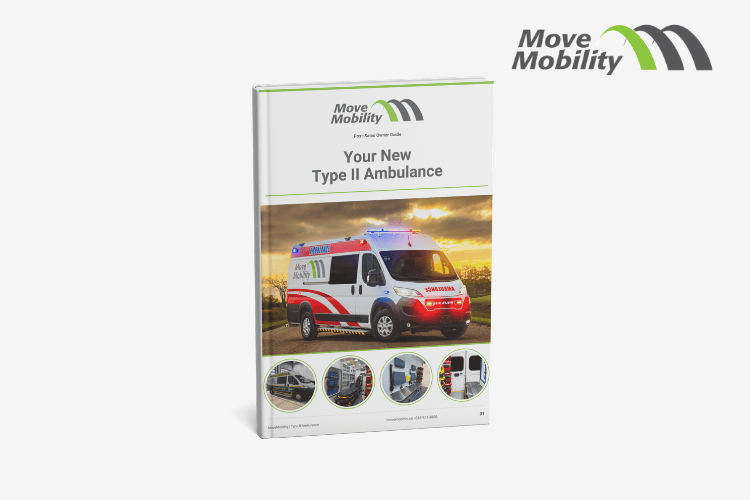
This is one of the reasons we focused our efforts on building a Type 2 ambulance platform on the RAM ProMaster 159″ chassis.
It’s nimble. Easy to drive. Easier to park. Easier to navigate through tight cores.
The ProMaster has a tighter turning radius than many traditional truck-based platforms. It sits lower to the ground. Crews often tell us it feels more like driving a large van than a heavy-duty truck.
And here’s the part that surprises people.
Many say it feels much bigger on the inside than it looks from the outside.
You still get about 6’2” of interior stand-up height, which supports crew comfort and patient care. You’re not sacrificing functionality just to gain maneuverability. You’re balancing both.
In dense Canadian cities, that balance can matter.
A Type 2 platform won’t magically fix every factor affecting emergency response times. Traffic volume, dispatch efficiency, and hospital offload delays all play roles. But if tight turns, narrow streets, and packed lots are part of your daily reality, vehicle size is worth examining honestly.
Because at the end of the day, your goal isn’t just to hit a metric.
It’s to reach someone faster, reduce stress on your crew, and gain more control over the drive.
Does a type 2 ambulance make sense for your organization?
If you’re reading this article, you’ve likely already taken a step back and looked at your emergency response times.
Now comes the practical question.
Does a Type 2 ambulance actually make sense for your organization?
There isn’t one universal answer. Every service is different. Your geography, staffing model, and call volume all matter. What we can do is help you think through it clearly.
1. Start with the reality on your streets
Before comparing spec sheets, start with your lived experience.
Ask yourself:
- Are your drivers frustrated in traffic? If crews regularly struggle with tight turns, side streets, or packed parking lots, maneuverability is worth serious thought.
- Do your calls cluster in dense urban areas? Condo towers, downtown cores, university campuses, and older neighbourhoods often favour smaller footprints.
- Have you had near-miss curb strikes or mirror close calls? Frequent tight navigation can add stress and slow down arrivals.
- Do winter conditions shrink your road space? Snowbanks in places like Winnipeg or Ottawa reduce clearance and turning room.
If you’re nodding to more than one of those, it may be time to explore a platform designed for urban agility.
2. Consider your average response time for emergency services
Your reports likely show an overall average response time for emergency services. That number matters. But averages can hide friction.
Think about:
- How often are calls delayed in the final 500 metres? The last turn into a lot or alley can be where time is lost.
- Are delays consistent in certain neighbourhoods? Recurring patterns often point to physical access issues.
- Do crews feel rushed before they even arrive? High stress during navigation can affect performance on scene.
A smaller, more nimble unit won’t solve dispatch bottlenecks or hospital offload delays. Still, it can reduce urban friction that adds minutes on the road.
3. Evaluate operational fit
A Type 2 ambulance built on a RAM ProMaster 159″ chassis offers a different balance than a traditional Type 1 or Type 3.
Here’s what to think about:
- Urban agility: Tighter turning radius supports smoother navigation in city cores.
- Driver confidence: Many operators describe it as easier to handle in traffic.
- Interior space: With approximately 6’2” of interior stand-up height, crews can still work comfortably.
- Perception vs reality: From the outside, it looks compact. Inside, it often feels more spacious than expected.
That combination matters when your goal is to protect emergency services response times in dense areas.
Ask yourself these strategic questions
If you’re weighing options, these questions can help guide your decision:
- Are most of your high-acuity calls within city limits? Urban-focused services often benefit from maneuverability.
- Is recruitment or training impacted by vehicle size? Easier-to-drive platforms can broaden your driver pool.
- Do you operate mixed fleet models? Some organizations deploy Type 2 units in downtown zones and larger units in rural areas.
- Are you planning for future densification? Cities across Canada are building up, not out. More condos, tighter streets, more congestion.
- Does your team value reduced driver fatigue? Less wrestling with a large chassis can lower stress over long shifts.
These aren’t sales questions. They’re operational ones. You know your system best.
Think about community impact
At the end of the day, improving response times for emergency services isn’t about vehicles. It’s about outcomes.
Faster arrivals can mean:
- Earlier intervention
- Greater public confidence
- Reduced crew stress
- Stronger alignment with municipal targets
If a more maneuverable platform helps close even part of the gap between dispatch and patient contact, it deserves consideration.
That doesn’t mean replacing every unit with a Type 2. Many services benefit from a mixed fleet strategy. Larger units still serve vital roles in rural transport, bariatric response, and specialty care.
But if your service area is dense, traffic-heavy, and growing vertically, it’s worth asking whether your fleet reflects that reality.
Because your mission isn’t to drive a specific chassis.
It’s to reach people quickly, safely, and with dignity.
And if a more agile ambulance platform supports stronger emergency response times in your city, that’s a conversation worth having.
Ready to improve emergency response times?

You came here because you’re feeling the pressure around emergency response times. Targets are tight. Urban streets are tighter. And you’re asking an honest question about whether your current fleet is helping or quietly slowing you down.
After reading this, here’s what you now know:
- Emergency response times across Canada vary widely, especially in dense urban cores.
- Vehicle size can influence maneuverability, which can affect the average emergency response time in tight areas.
- A Type 2 ambulance offers an agile option, without sacrificing interior working space.
That’s the shift from past to present. You started with the frustration of congestion, awkward turns, and unpredictable arrival times. Now you have a clearer lens to evaluate whether your vehicle design aligns with your city’s reality. The future state you’re aiming for is simple. Faster, smoother arrivals. Less driver stress. Stronger public confidence.
At MoveMobility, we’ve built our reputation by listening closely to EMS leaders across Canada and by designing solutions that address real operational challenges. We’re proudly Canadian, deeply focused on safety and compliance, and excitedly putting the finishing touches on our new Type 2 ambulance platform as we prepare to bring it to market. Our goal has always been clear. Help organizations reach people safely and confidently when it matters most. If you have questions or want to explore whether a Type 2 platform fits your service model, click the button below to talk to an ambulance expert.
If you’re not ready to speak with an ambulance expert yet, we have a few additional resources to guide your next step.
Recommended next reads
- What are the three different types of ambulances? Understand how Type 1, Type 2, and Type 3 platforms compare so you can choose the right fit for your service area.
- Emergency response units: van vs. truck with capsule: A deeper look at maneuverability, space, and operational differences between van-based and truck-based units.

 English
 French