

Are you looking for alternative ways to fund a clinique mobile in Canada? Many teams are. In 2023, about 17% of adults didn’t have a regular health care provider, which means more people need care brought to them. If mobile clinic funding stalls, outreach slows, screening drops, and long trips for care continue. The goal is clear. You want a funded unit that meets people where they live and gives your team a safe, private space to help.
We’re MoveMobility. For over 20 ans, we’ve worked with organizations like yours and Centre de santé communautaire Quest to launch programs that reach more people with less stress. We listen first and build second, and we keep this guide unbiased because we know you have options.
Voici ce que vous apprendrez :
- Testamentary charitable trust: We explain what a testamentary trust is and how it can back your program.
- Charitable bequests and designated endowments: We outline how legacy gifts can support your program.
If that sounds like the path you need, let’s get into it.
What’s a testamentary charitable trust, and how does it work?
When people ask about alternative ways to fund a mobile clinic, a common question is this: What is a testamentary charitable trust, and how can it help our program? Here’s how these trusts work.
A testamentary charitable trust is a gift someone sets up in their Will. It starts after they pass away. The Will appoints a trustee to hold money or assets and use them for a charity or health program. The trust can fund one project, like a mobile clinic, or support a cause every year.
Pensez-y de la manière suivante : A community member wants care to reach people who can’t travel. They leave part of their estate to a trust. That trust sends money each year to help run your clinic, pay staff, buy fuel, or replace equipment. It keeps support steady so your team can plan with confidence.
How it works in practice
- What it is: A legal plan in a Will that sets money aside for a charitable purpose.
- When it starts: After the person passes away, not before.
- Who is involved: The donor, their lawyer, a trustee, and your charity or qualified donee.
- How it pays: The trust can send annual payments or a one-time grant to your mobile clinic budget.
Why does it fit mobile healthcare?
- Reliable funding: Regular payments help cover fuel, clinical supplies, and outreach days.
- Flexible use: Donors can name broad goals, like mental health or screening, so funds follow real needs.
- Local impact: Gifts can be directed to your town, region, or priority group.
Let’s take a quick look at three hypothetical examples of how these trusts might work.
- Northern Alberta: A retired nurse in Grande Prairie leaves $250,000 to a testamentary charitable trust. The trustee pays your program $20,000 each year. You add two clinic days a week in Peace River and High Level through the winter.
- Nova Scotia South Shore: A family sets up a trust that funds mobile counselling visits in Lunenburg County. Their gift covers data plans, a part-time counsellor, and fuel for coastal routes.
- Manitoba Parkland: A farmer’s estate buys a clinique mobile de vaccination and covers service plans, so your unit can hold more pop-up clinics during spring roads.
How can you talk to donors about it?
You can meet potential donors where they are and with simple language.
- Start with purpose: “Your legacy can help bring care to people who can’t travel.”
- Offer a path: “A testamentary charitable trust lets your wishes support our mobile clinic for years.”
- Show impact: “Each year, your gift could fund 300 extra visits across our region.”
- Invite help: “We can share a sample paragraph for your lawyer.”
Key points to share with your board
- Set rules early: Agree on how trust payments will be used, tracked, and reported.
- Keep it transparent: Send donors’ families simple updates. Photos and short notes build trust.
- Work with professionals: Ask your local lawyer or community foundation to confirm the best setup for your area.
Next, let’s take a look at charitable bequests.
What are charitable bequests, and how do they work?
Charitable bequests are another one of the alternative ways to fund a mobile clinic in Canada. A bequest is a gift named in a person’s Will that goes straight to your charity after they pass away. It can be cash, a percentage of the estate, stocks, or even equipment. Simple idea. Big impact. It helps your team plan routes, add clinic days, and care for people close to home.
Comment cela fonctionne-t-il ? Supporters write their Will and name your organization for a gift. When the estate is settled, your charity receives that gift. You can use it for fuel, supplies, staff time, Wi-Fi, or outreach in the exact communities you serve.
What a bequest can look like
- Specific amount: “I give $25,000 to ABC Health Charity for the mobile clinic.”
- Percentage of estate: “I give 2% of my estate to the mobile clinic program.”
- Residual gift: “I give the rest of my estate to the mobile clinic after other gifts.”
- Gifts of securities or property: Shares or an item sold for clinic funding.
For example: A retired teacher in Saskatoon leaves 2% of her estate. Your program adds weekly diabetes checks in Prince Albert and North Battleford.
Bequests vs. testamentary charitable trusts
By now, you might be wondering how bequests differ from a testamentary charitable trust. Here’s a quick, clear look at that.
| Topic | Charitable bequest | Testamentary charitable trust |
| How it’s set up | Named as a gift in a Will | Trust terms written in a Will |
| When it pays | Usually, a one-time transfer after the estate closes | Can pay out yearly over time |
| Who manages funds | Your charity after it receives the gift | A trustee manages and sends payments |
| Good for | Simple gifts and quick impact | Long-term, steady funding with rules |
Both options can support care close to home. Think of a bequest as something that’s simpler and faster. A testamentary charitable trust can give you yearly support and stronger guardrails.
Why bequests fit mobile care
- Simple to explain: Easy for donors and families to understand.
- Flexible for needs: You can fund fuel, clinical supplies, or extra clinic days.
- Local focus: Donors can name your city, region, or program priority.
How can you apply for bequests?
You don’t fill out a form. You invite supporters to include your charity in their Will. Here’s a friendly path your team can use:
- Add a page on your site: Share a short “Planned Giving” page with sample wording, your legal name, and your CRA number.
- Offer simple wording: “I give ___ to [Charity Legal Name] to support the mobile clinic program.”
- Give options: Amount, percentage, or residual gift. Keep it plain.
- Partner locally: Ask a community foundation or estate lawyer to speak at a short info session.
- Make it real: Share one clear budget use, like “$15,000 funds 10 extra clinic days in Durham Region.”
- Name a contact: A real person with a phone number and email builds trust.
- Thank families: With permission, send a warm note and a one-page impact update.
Quick script you can use with a supporter: “Your legacy can help bring care to neighbours who can’t travel. A bequest in your Will is simple and powerful. We can share sample wording for your lawyer and show the impact your gift can make.”
Charitable bequests give your program a clear path to new funding. They work beside a testamentary charitable trust, and both sit inside the toolbox of alternative ways to fund a mobile clinic across Canada.
What are designated endowments, and how do they work?
A designated endorsement is the third alternative way to fund a mobile clinic. It’s simple to explain to donors and easy for your team to plan around. Think of it as a forever fund that supports care year after year.
A designated endowment is a pool of money that a donor gives to a public foundation, often a community foundation. The donor names your program as the beneficiary. The foundation invests the capital. Your clinic then receives a grant each year from the fund’s earnings based on the foundation’s spending policy. The capital stays invested, so support continues in future years too.
Why does this help mobile care?
- Reliable support: Annual payouts help you plan routes, book staff, and buy supplies.
- Local focus: Donors can direct gifts to your town or region.
- Light admin: The foundation handles investing and tax receipting. Your team focuses on care.
- Clear story: You can show donors how a one-time gift turns into help every year.
How does it work?
- Donor sets up the fund: They create a designated endowment at a foundation and name your mobile clinic program.
- Foundation invests the gift: The capital is pooled with other funds for steady growth.
- Your clinic receives a grant each year: You use it for fuel, staff time, supplies, or outreach days.
- You report impact: Send a short update with photos and numbers. Keep it human and clear.
Let’s take a look at a few hypothetical examples.
- Okanagan, BC: A donor creates a designated endowment and names your counselling van in Kelowna. Each year, the payout covers data plans and evening visits in Lake Country and West Kelowna.
- Thunder Bay, Ontario: A family builds a fund for diabetes screening on First Nation partner routes. The grant adds a second clinic day each week through winter roads.
- Halifax, Nova Scotia: A retired social worker sets up a fund to support mental health stops on the Peninsula and Dartmouth. The grant pays for a part-time counsellor and transit passes for clients.
How does it differ from the other options?
Here’s a look at how designated endowments differ from the previous funding options we’ve talked about:
| Option | What it does | How do you get funds? |
| Charitable bequest | One-time gift in a Will | Lump sum after the estate closes |
| Testamentary charitable trust | Ongoing gifts from a trust set up in a Will | Scheduled payments managed by a trustee |
| Designated endowment | Permanent fund at a foundation with you named as beneficiary | Annual grants from investment earnings |
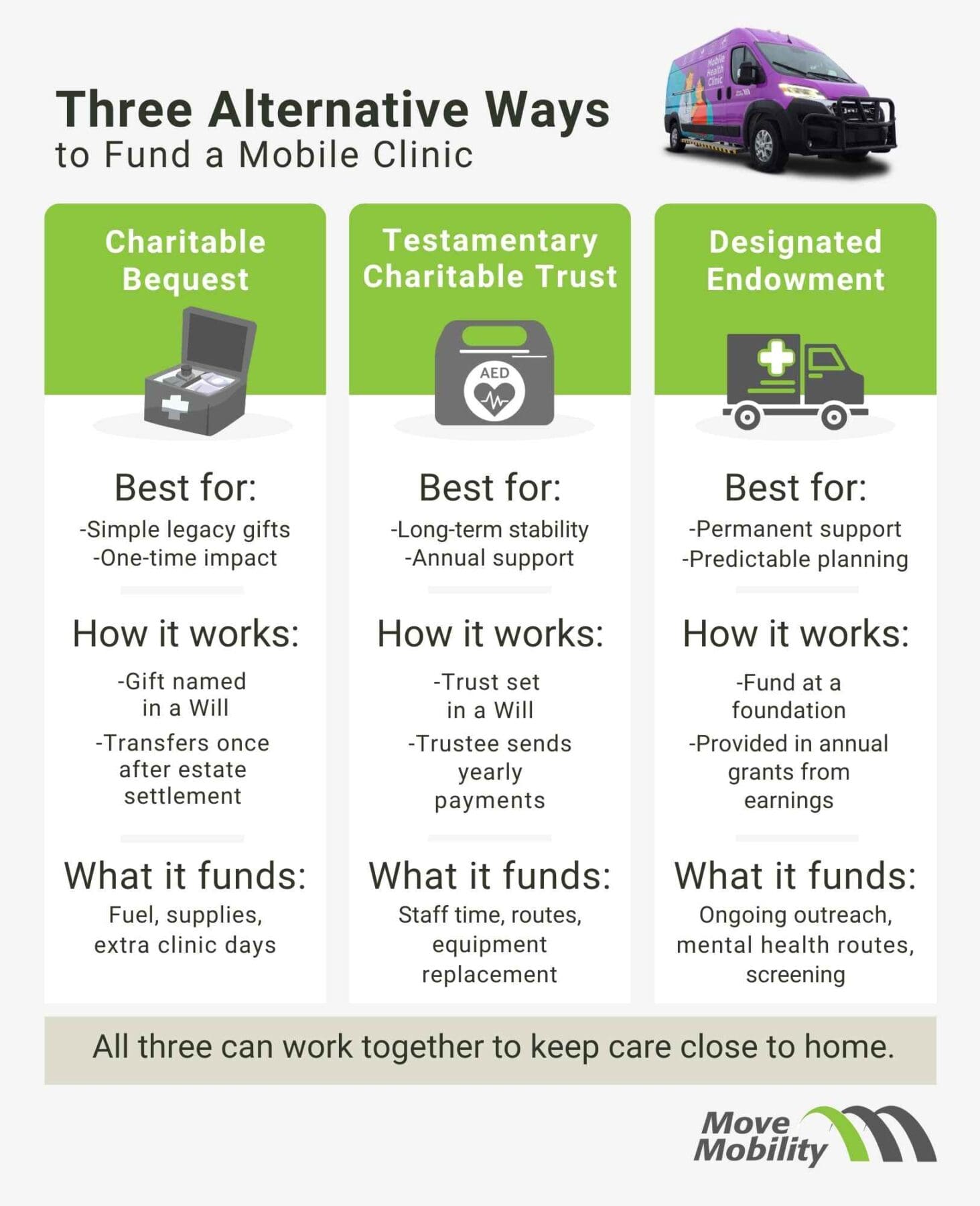
All three can work together. Many teams invite bequests for near-term needs, a testamentary charitable trust for multi-year support, and a designated endowment for long-term stability.
How do you talk to donors about it?
- Lead with purpose: “Your gift can keep care close to home every year.”
- Show the math: “A one-time gift can create a yearly grant for fuel, supplies, and nurse hours.”
- Offer a path: “We can connect you with our local community foundation and share sample wording.”
- Make it real: “This grant could add 200 more visits across the region next year.”
- Keep it warm: Thank the donor and family with a short, kind update.
A designated endowment gives your program calm in the budget. It turns a caring gift into steady support so you can reach more people, plan with confidence, and keep care moving to the places that need it.
Got any questions about alternative ways to fund a mobile clinic?
You likely landed on this article after struggling to get funding for your mobile clinic program.
Here’s a recap of what you learned:
- Testamentary charitable trust: A gift in a Will that creates steady yearly support for your clinic through a trustee.
- Charitable bequests: A simple gift in a Will that gives your program a one-time boost for fuel, staffing, and supplies.
- Designated endowments: A permanent fund at a community foundation that pays your clinic a grant each year.
Across Canada, we’re recognized as a Ford Qualified Vehicle Modifier, and we follow Canadian safety rules that matter for your patients and staff. If you have questions, click the button below to talk to a mobility expert.
If you’re not ready to talk to a mobility expert yet, here are three helpful reads to keep you moving:
- How much does a mobile medical van cost in 2026? Learn about the cost of a mobile medical van so you can budget more effectively.
- How to apply for funding for mobile medical vehicles: Here’s a clear path to follow when applying for funding for mobile medical units.
- Five steps to buying a mobile medical van: Learn the full path from first call to delivery so your team can plan with confidence.
 English
  French