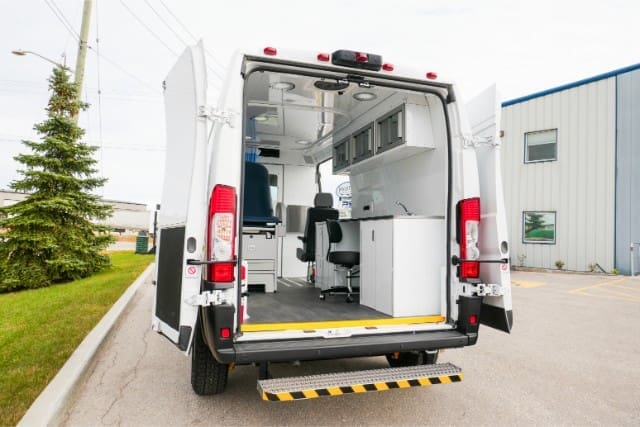
Mobile clinics are often misunderstood, and that creates real tension for hospital leaders across Canada. You’re facing long wait times, staff burnout, and patients who delay care because travel is hard or clinics are full. According to the Canadian Institute for Health Information, about 1 in 5 Canadian adults do not have a regular health care provider, which makes routine care harder to access in many regions.
When people can’t get care early, hospitals see the fallout later. More ER visits, more acute cases, and more pressure on teams who are already doing their best. Building new space takes years, and budgets are tight. Leaving things as they are risks burnout, lost trust, and communities feeling left behind. The desired state is different. Strong local hospitals supported by flexible care that reaches people sooner and closer to home. When that gap closes, hospitals protect capacity and patients stay connected to care.
At MoveMobility, we’ve spent over 20 years working alongside healthcare organizations across Canada to reduce barriers to healthcare and transportation. We’ve manufactured more than 150 mobile medical units, built under Ford Pro Upfitter and Stellantis QPro certifications, and carrying the National Safety Mark. We’ve partnered with organizations like Quest Community Health Centre, supporting access where hospitals can’t always be present. We also know thoughtful buyers compare options, and that’s a healthy part of planning.
In this article, you’ll learn:
- How mobile clinics support local hospitals instead of replacing them.
- Where mobile medical clinics fit into Canadian care models.
- Why hospitals use them to strengthen access, capacity, and trust.
How do mobile clinics support local hospitals instead of replacing them?
There’s a common worry we hear from healthcare leaders across Canada. If mobile clinics bring care into communities, does that pull patients away from local hospitals? It’s a fair question. You’ve invested years building trust, services, and teams. The last thing you want is something that weakens what already works.
Here’s the reality: Mobile clinics don’t compete with hospitals. They protect them.
Canada has more than 1,200 hospitals, many serving wide geographic areas with limited staff and space. At the same time, nearly 1 in 5 Canadians live in rural or remote regions, where access to routine care often means long drives, missed work, and delayed appointments.
That gap shows up fast. People wait longer. Conditions worsen. Emergency departments carry the load. Hospital teams feel the strain. Mobile clinics step in before that pressure reaches your doors.
How do mobile clinics extend the reach of local hospitals?
Mobile clinics act like an extra set of hands for your hospital, reaching places your building can’t.
They support local hospitals by handling care that doesn’t need a hospital bed but still matters deeply to patient outcomes.
Here’s what that looks like in practice:
- Routine and follow-up care: Mobile clinics handle check-ins, screenings, and follow-ups closer to home.
- Earlier intervention: Small health issues get attention before turning into emergencies.
- Clear referral pathways: When something serious appears, patients are directed back into hospital care quickly.
- Better use of hospital space: ERs and inpatient units stay focused on higher-acuity care.
This doesn’t shrink the hospital’s role. It sharpens it.
CIHI reports that rural patients often travel long distances for hospital services, and one in four rural hospital stays involves a significant travel burden. That travel delay often pushes people to wait until care feels urgent.
Mobile medical clinics reduce that delay. They bring care earlier, which protects hospital capacity later.
Why mobile clinics are built to work with hospitals
Hospitals weren’t designed to solve every access issue alone. Buildings don’t move. Communities do.
Mobile clinics are most effective when they operate as part of a hospital-led care model. That’s where the strongest results show up.
From what we see across Canada, hospitals use mobile clinics to:
- Support discharged patients who need follow-up
- Reach patients who struggle with transportation
- Serve remote communities tied to a regional hospital
- Reduce non-urgent ER visits
- Strengthen trust with underserved populations
In Northern Manitoba, Northern Ontario, and parts of the Territories, hospitals often serve hundreds of kilometres of territory. Mobile clinics help those hospitals stay connected to their full service area, not just the people who can physically reach the building.
Mobile clinics reduce pressure instead of shifting it
One fear is that mobile clinics simply move the workload somewhere else. In practice, the opposite happens.
When mobile clinics support local hospitals, teams see:
- Fewer missed appointments
- Better patient follow-through
- Lower stress on emergency departments
- Stronger continuity of care
Mobile health programs help connect people who might otherwise delay care or rely on emergency services back into planned care pathways.
That matters because hospitals don’t benefit when patients show up late and sicker. They benefit when patients arrive earlier, informed, and supported.
What mobile clinics are not designed to do
Mobile clinics are not mini hospitals. They don’t replace surgery units, trauma care, or inpatient services. They fill the space between community need and hospital care.
They are not meant to:
- Replace hospital infrastructure
- Pull funding away from hospitals
- Compete for the same patients
- Operate without coordination
Instead, they strengthen the system around the hospital, so your teams can focus on what only hospitals can do.
When mobile medical clinics are used this way, hospitals don’t lose relevance. They gain breathing room.
And that sets the stage for the next question many leaders ask. Where do mobile clinics make the biggest impact alongside hospitals, and how do you decide if they fit your care model?
That’s where we’ll go next.
Where do mobile clinics fit into Canadian care models, and how do you decide if they fit yours?

When people ask where mobile clinics fit in Canadian healthcare, the honest answer is this: They fit where gaps already exist. And every care model has gaps, even the strong ones.
Canada’s healthcare system is built around local hospitals, primary care providers, and community health services. That structure works well for many people. But it doesn’t always reach everyone equally. Geography, staffing shortages, aging populations, and transportation barriers create pressure points. That’s where mobile medical clinics earn their place.
They don’t sit outside the system. They sit between parts of it and help them work better together.
Where mobile clinics commonly fit in Canadian care models
Across Canada, we see mobile clinics used in a few consistent ways. These aren’t experimental ideas. They’re practical responses to real challenges.
Mobile clinics often support:
- Hospital outreach programs: Extending services into rural towns tied to a regional hospital.
- Community health centres: Bringing care to people who struggle to attend fixed locations.
- Post-discharge follow-up: Helping patients stay on track after leaving the hospital.
- Preventive care and screening: Catching issues early before they reach emergency care.
- Specialty clinics on rotation: Dental, mental health, chronic care, or harm reduction services.
In provinces with large rural footprints like Manitoba, Saskatchewan, and Northern Ontario, mobile clinics help hospitals stay connected to communities hours away. In urban areas, they often support underserved neighbourhoods where access barriers still exist despite nearby hospitals.
Statistics Canada reports Canada’s population is aging quickly, with nearly 1 in 5 Canadians now aged 65 or older.
That shift increases demand for follow-up care, chronic disease management, and transportation support. Mobile clinics help local hospitals meet those needs without expanding buildings or stretching staff even thinner.
How mobile clinics connect, not compete
A key reason mobile clinics work in Canadian care models is integration. The most effective programs operate with clear links back to hospitals and primary care teams.
Strong programs include:
- Shared referral pathways
- Clear documentation and reporting
- Coordination with hospital clinicians
- Defined scopes of care
- Community partnerships
This keeps care connected. Patients don’t feel passed around. Hospitals don’t lose visibility. Everyone stays aligned around outcomes.
Many Canadians struggle to get timely follow-up care, especially after hospital discharge. Gaps in continuity often lead to avoidable readmissions.
Mobile clinics help close that loop. They support patients where life actually happens.
How do you decide if a mobile clinic fits your organization?
This is the part that matters most. Mobile clinics don’t fit every situation the same way. Deciding if they fit yours starts with asking the right questions.
Here are the signals we see when mobile clinics make sense.
You may be a good fit if:
- Patients miss appointments due to distance or transportation
- Emergency visits increase for issues that could be managed earlier
- Follow-up care falls through after discharge
- Your hospital serves a wide geographic area
- Community trust needs strengthening
Mobile clinics help when access is the problem, not quality of care.
Questions to ask before moving forward
Before adding a mobile clinic, hospital leaders usually step back and assess the gap they want to close.
Ask yourself:
- Where are patients falling out of the care pathway?
- What services don’t need a hospital bed?
- Which communities struggle to reach us?
- Where is staff time being stretched the most?
If the answers point to access, travel, or follow-up challenges, mobile medical clinics often fit naturally into your model.
Why does fit matter more than features?
It’s tempting to focus on equipment or layouts. But fit is about outcomes.
When mobile clinics align with your care model, you see fewer late-stage cases, stronger community ties, and better use of hospital resources. That’s when they stop feeling like an add-on and start feeling like part of the system.
In the next section, we’ll look at how mobile clinics improve capacity, protect staff wellbeing, and support long-term sustainability for local hospitals across Canada.
How do mobile clinics support hospital teams and long-term sustainability?

By the time healthcare leaders consider mobile clinics, the system is usually holding on by a thread. Not because care quality is poor, but because people are tired. Teams are carrying more than their share. And every decision feels like it has a human cost attached to it.
This is where the conversation needs to shift. Sustainability isn’t only about buildings, budgets, or flow. It’s about whether the people inside local hospitals can keep doing this work without burning out.
Capacity is a people problem before it’s a space problem
Hospitals often talk about capacity in numbers. Beds. Hours. Shifts. But behind every number is a person.
When access gaps push patients to arrive later and sicker, hospital teams absorb that weight. Nurses manage higher acuity. Physicians juggle impossible schedules. Support staff try to keep pace. Over time, the strain shows up as fatigue, frustration, and turnover.
You likely always hear about ongoing workforce stress across Canadian healthcare, driven by workload intensity and system pressure.
Mobile medical clinics help redistribute that pressure in a way that respects people, not just processes.
They don’t ask hospital teams to work harder. They help teams work differently.
How do mobile clinics support staff without adding more work?
This is the part that often gets missed. Mobile clinics are not extra tasks for hospital staff. When designed well, they reduce the weight teams carry.
Here’s how that support shows up:
- Patients arrive better prepared: Follow-ups, education, and early checks happen before hospital care is needed.
- Care feels more planned: Fewer last-minute crises means fewer emotional spikes for staff.
- Roles feel clearer: Hospitals focus on complex care. Mobile clinics handle what doesn’t require hospital infrastructure.
- Moral distress decreases: Teams see fewer cases where delayed access caused avoidable harm.
That last point matters more than most metrics. When clinicians feel they’re always reacting instead of helping early, it takes a toll.
Retention matters as much as recruitment
Across Canada, hospitals are trying to hire their way out of pressure. But retention is just as important.
People stay when work feels manageable. When care feels meaningful. When the system supports them instead of draining them.
Mobile clinics support retention by changing the rhythm of care.
They create space for hospital teams to:
- Spend more time on complex cases
- See better outcomes from earlier care.
- Build trust with communities instead of seeing them only in crisis
That sense of purpose matters. It’s one of the strongest reasons people stay.
Sustainability looks different across regions
Long-term sustainability doesn’t look the same everywhere. In Northern regions, it’s about reach and continuity. In urban centres, it’s about equity and access. In growing communities, it’s about flexibility.
Mobile clinics adapt to those differences without forcing hospitals into permanent changes they may not need.
That flexibility supports sustainability by:
- Adjusting services as community needs shift
- Scaling care without expanding hospital footprints
- Supporting seasonal or rotating programs
- Strengthening hospital presence beyond the building
Hospitals remain the anchor. Mobile clinics act as the connective tissue.
Why this approach protects the future of local hospitals
Local hospitals carry more than medical responsibility. They carry community trust. When teams are overwhelmed, that trust erodes quietly.
Mobile clinics help protect that trust by showing people the system is responsive. That care doesn’t stop at the door.
Over time, this creates a healthier system for everyone involved. Patients feel seen earlier. Staff feel supported longer. Hospitals stay strong without asking people to give more than they have.
Got any questions about mobile clinics?

You came to this article because something feels off. Access gaps are growing, teams are stretched, and too many patients reach your hospital later than they should. You’re trying to protect what works today while planning for a system that can hold up tomorrow. That tension is real, and you’re not alone in feeling it.
Here’s what you’ve learned along the way:
- Mobile clinics strengthen local hospitals by extending care, not competing with it
- They fit into Canadian care models where access, follow-up, and continuity break down
- When used well, mobile medical clinics protect staff wellbeing and long-term sustainability
At MoveMobility, this work is deeply personal. We don’t start with vehicles. We start with people, communities, and outcomes. Over two decades, we’ve helped healthcare organizations across Canada turn complex access challenges into practical, human solutions. Our teams design and build mobile clinics that work in real conditions, from dense urban centres to the most remote regions.
That experience matters because planning mobile care is as much about trust and partnership as it is about equipment. If you have questions, our mobility experts are here to listen, pressure-free, and help you think through what makes sense for your organization.
If you’re not ready to talk to a mobility expert yet, we have a few other resources you should check out to learn more.
Recommended next reads
- How can a mobile clinic reduce ER wait times? Learn how mobile clinics help hospitals manage demand before patients reach emergency care.
- 5 steps to buying a mobile medical van: A practical guide that walks through the stages of acquiring your mobile medical van.
- How much does a mobile medical van cost? Get clarity on budgets, pricing ranges, and what drives cost so you can plan with confidence.

 English
 French