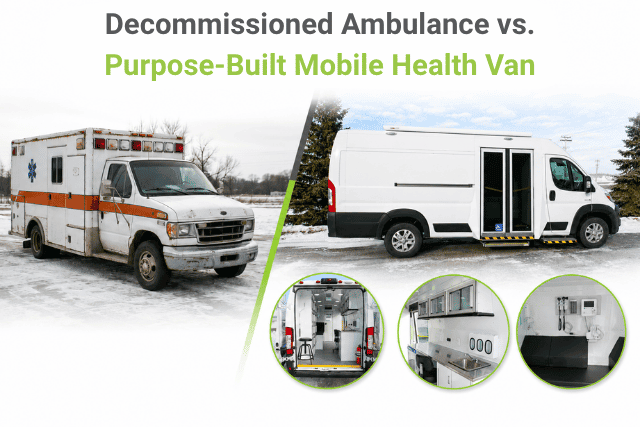
Is your organization considering a decommissioned ambulance as a mobile health van? It’s a tempting idea. The price tag on a used one can look like a win. But a decommissioned ambulance vs. a purpose-built mobile health van is a comparison that deserves a much closer look before you commit.
Older decommissioned ambulances come with serious baggage. High repair costs, an intimidating appearance that keeps the people you serve away, and cramped interiors where nobody can stand upright and deliver real care. That gap between what you need and what a retired emergency vehicle can offer is bigger than most organizations realize until it’s too late.
Au MoveMobility, we’ve spent over 20 years building vehicles that help organizations remove barriers to healthcare across Canada. We’ve manufactured over 480 wheelchair vans and 180 unités médicales mobiles in the past three years alone. We’re proud recipients of the Prix d'innovation DARE 2026, and we hold the Marque nationale de sécurité, Ford Pro Upfitter, and Stellantis QPro certifications. We’re not the only manufacturer out there, and this article is here to help you make the right call.
Here’s what you’ll learn:
- Why decommissioned ambulances carry hidden costs most organizations don’t see coming
- How stigma around ambulance-style vehicles reduces patient trust
- Why interior design and standing room matter more than you’d think
- How purpose-built mobile health vans close the gaps that retired emergency vehicles leave open
Do decommissioned ambulances cost more than you’d expect?
A decommissioned ambulance looks like a deal on the surface. You’re getting a heavy-duty vehicle for a fraction of the cost of something new. But here’s what most organizations discover the hard way: the sticker price is just the beginning.
Think of it like buying a used car with 400,000 kilometres on it. Sure, it runs today. But what about six months from now, when something major breaks down in the middle of a frigid Manitoba winter?
The repair bills can add up fast
Decommissioned ambulances are retired from service for a reason. By the time they hit the resale market, they’ve typically logged hundreds of thousands of kilometres responding to emergencies. That kind of wear takes a serious toll.
Here’s what you’re likely walking into:
- Engine and drivetrain repairs: High-mileage vehicles need frequent and expensive mechanical work.
- Electrical issues: Older ambulance electrical systems are complex and costly to fix.
- Heating and cooling failures: A big deal in Canada’s climate, and often one of the first things to go in aging vehicles.
- Hard-to-find parts: Ambulance components aren’t always easy to source, which means longer wait times and higher labour costs.
Picture this: your mobile health program is running in Northern Ontario, and your decommissioned ambulance breaks down in January. Your team is grounded, your clients miss care, and you’re looking at a repair bill that could’ve gone toward a purpose-built van instead. It happens more than you’d think.
The ongoing costs that never seem to stop
Beyond repairs, the ongoing maintenance costs on an older decommissioned unit just keep coming. Inspections, certifications, and trying to keep an aging vehicle up to current safety standards all add up fast.
Purpose-built mobile health vans start fresh. They’re built on current platforms with up-to-date systems, supported parts networks, and warranties that actually protect your investment. Organizations like Centre de santé communautaire Quest have seen firsthand how the right vehicle changes what’s possible for their communities.
And the hidden costs of poor patient transport go beyond the vehicle itself. Downtime means missed appointments. Missed appointments mean people who needed care didn’t get it. No budget line can fully capture that cost.
So before you sign on an “affordable” decommissioned unit, it’s worth asking: affordable for how long? That question leads into another problem with retired ambulances that doesn’t get talked about nearly enough: what they signal to the very people you’re trying to help.
How can the look of a decommissioned ambulance work against you?
Here’s something that might surprise you. The vehicle you show up in says a lot before anyone even opens the door.
For many people, especially those in vulnerable or underserved communities, the sight of an ambulance triggers an immediate emotional response. And it’s rarely a welcoming one. Ambulances are associated with emergencies, crises, and fear. That’s not a judgement. That’s just the reality of what that vehicle represents to most people.
Now imagine you’re trying to run a mobile health program that’s supposed to feel approachable, safe, and community-centred. You pull up in a decommissioned ambulance, maybe still white with faded markings on the side. Do you think someone who’s already hesitant about seeking care is going to walk up and knock?
Probably not.
Stigma is a real barrier to care
This isn’t just a gut feeling. Research consistently shows that the physical environment and appearance of healthcare settings directly impacts whether people choose to access care. That applies to mobile units, too.
For communities that have experienced trauma, systemic neglect, or negative interactions with institutions, an ambulance-style vehicle can feel like an extension of a system that hasn’t always treated them well.
This is especially true in:
- Communautés autochtones across Northern Canada, where distrust of institutional healthcare runs deep for well-documented historical reasons.
- Low-income urban neighbourhoods where emergency vehicles are often associated with crisis rather than care.
- Mental health and addiction outreach programs where stigma already makes it hard enough to get people through the door.
Organizations like Lil’wat Nation have recognized this directly. When they launched their mobile health van, the focus was on creating something that felt welcoming and community-driven, not clinical and intimidating. That decision wasn’t cosmetic. It was strategic.
What your vehicle communicates without saying a word
A purpose-built mobile health van can be wrapped in bright, community-friendly colours. It can feature Indigenous artwork, local imagery, or your organization’s branding. It can look like it belongs in the neighbourhood it’s serving.
That visual signal tells people: this is for you. Come in. You’re safe here.
A decommissioned ambulance sends a very different message. Even with a fresh coat of paint, the boxy shape, the high roofline, and the overall silhouette of an old emergency vehicle is hard to disguise. People recognize it. And for many, that recognition comes with baggage.
Think about culturally sensitive care for a moment. It starts the moment someone sees your vehicle parked in their community. First impressions shape whether someone approaches or walks the other way.
The ripple effect on your program’s impact
When people don’t show up, your program’s impact shrinks. It’s that simple. You can have the best clinicians, the most generous funding, and the most genuine intention to help. But if the vehicle itself is keeping people away, none of that reaches the people who need it most.
Mobile health programs are only as effective as their ability to earn trust. And trust starts at the curb.
A purpose-built van gives your team a fighting chance to make that first impression a good one. And that connects directly to another practical challenge with decommissioned ambulances that affects your staff just as much as your clients: what it’s actually like to work inside one.
Is working in a decommissioned ambulance tougher than it looks?
Let’s talk about something that rarely makes it into the sales pitch for a decommissioned ambulance: what it’s actually like to work inside one every single day.
Many older decommissioned ambulances, particularly Type III models built on Ford E-350 or E-450 chassis, have interior headroom that becomes a real problem for anyone over 5’8″ or 5’9″. Real-world accounts from people who’ve worked inside these vehicles are pretty telling: at 5 ‘9 “, you have to tilt your head slightly to the side just to stand up straight. Forum posts from people who’ve lived inside these vehicles put it plainly: at 5’9″, you have to tilt your head slightly to the side just to stand up straight. One person put it this way: they learned to instinctively cock their head every time they stood up, to the point they didn’t even think about it anymore.
Now picture doing that while conducting a health assessment. Or drawing blood. Or trying to have a calm, reassuring conversation with a patient who’s already anxious.
Your staff deserve better than a crick in the neck
Try bending your neck at an angle for eight hours. Do it five days a week. Give it a few weeks and see how your body feels. Neck strain, back pain, and general fatigue from cramped working conditions are well-documented occupational health concerns for healthcare workers. Putting your team in a vehicle that forces awkward postures all day isn’t just uncomfortable. It’s a staffing risk.
Good staff is hard to find. Keeping them healthy and comfortable is part of keeping them around.
Purpose-built mobile health vans are designed with the people working inside them in mind. The layout, the headroom, the placement of equipment; all of it is planned around how care actually gets delivered, not retrofitted around a box that used to carry a stretcher.
The layout problem goes beyond height
The standing room is just one piece of it. The interior layout of a decommissioned ambulance was designed for emergency response, not ongoing community health care.
En d'autres termes :
- Workflow doesn’t translate: Ambulances are set up for one specific job. Repurposing that layout for screenings, consultations, or wound care creates friction at every turn.
- Equipment placement is fixed: Older units often have built-in cabinetry and mounts that can’t easily be reconfigured for a different kind of care.
- Patient comfort is an afterthought: Emergency vehicles prioritize speed and function. Reducing patient discomfort in a clinical setting requires a completely different approach to interior design.
- Space feels clinical and cold: The sterile, utilitarian feel of an ambulance interior is the opposite of what builds trust with hesitant patients.
Organizations like the Canadian Mental Health Association in Algoma have recognized that the interior environment of a mobile unit shapes the quality of care that’s possible inside it. When you upgrade the vehicle, you upgrade the experience for everyone in it.
A purpose-built van gives you the flexibility to maximize space in a way that actually supports your program. You choose the layout, decide where equipment goes, and design around your team and the people they serve.
That kind of intentional design is what separates a vehicle that works against you from one that works for you. And when you combine better ergonomics, a welcoming interior, and a purpose-built layout, the difference in day-to-day operations is significant. Which brings us to the part that ties it all together: how purpose-built mobile health vans close every one of these gaps.
How do purpose-built mobile health vans close every gap a decommissioned ambulance leaves open?
At this point, the picture is pretty clear. A decommissioned ambulance might get you on the road. But a purpose-built mobile health van gets you where you actually need to go, and in a way that serves your team and your community properly.
Let’s put it side by side.
| Fonctionnalité | Decommissioned ambulance | Purpose-built MC Model van |
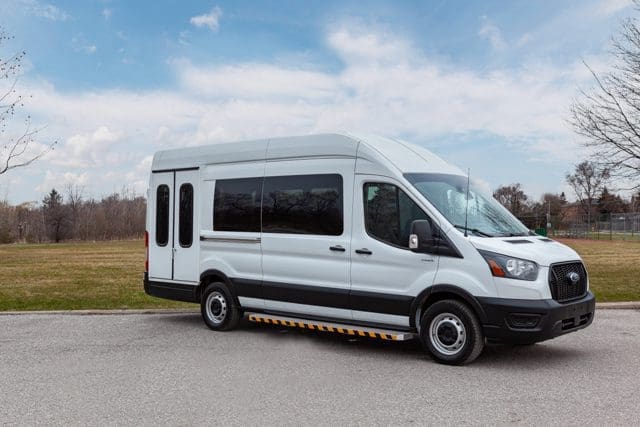
| Châssis | Aging Ford E-350/E-450 or similar, high mileage | Ram Promaster or Ford Transit, current platform |
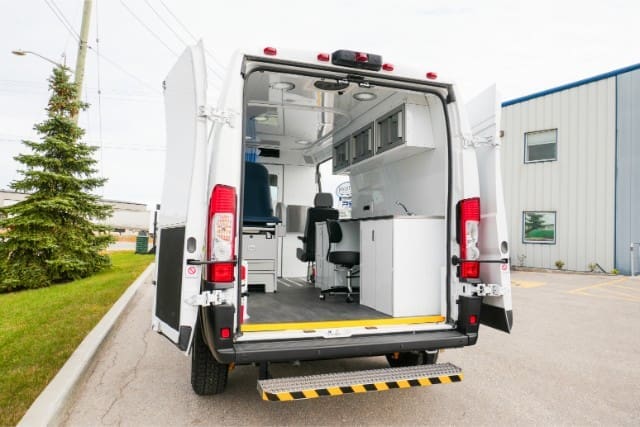
| Interior layout | Fixed emergency response setup, not designed for ongoing care | “Doctor’s office on wheels” with medical van layouts tailored to your program |
| Exam space | Stretcher mounts from previous emergency use | Exam bed with firm vinyl mattress and under-bed storage |
| Ébénisterie | Leftover emergency fittings, hard to reconfigure | Armoires de sol à plafond et armoires encastrées pour les médicaments et les fournitures |
| Workspace | Little to none designed for clinical consultation | Desk space with storage for equipment and records, rolling office chair secured during travel |
| Sink and fridge | Rarely included, retrofit is costly | Available as custom options built into the van from the start |
| Climate control | Aging systems prone to failure in Canadian winters | Dedicated rear heat and air conditioning system |
| Éclairage | Harsh emergency lighting, clinical and cold | Overhead lighting designed for a clean, comfortable environment |
| Raccordement électrique | Limited, built for emergency equipment only | Dedicated l'alimentation électrique supporting clinical equipment |
| Personnalisation | What you see is what you get | Fully customizable, including awning, diagnostic set, sink, fridge, and more |
| Garantie | Little to none on a used vehicle | Full conversion warranty and manufacturer support |
You deserve a van built around your program
With a purpose-built mobile health van, you can choose options like a spacious desk, office chair, sink, fridge, and storage to give clients a true one-on-one experience. The layout works around how you deliver care, not the other way around. MoveMobility
With a decommissioned ambulance, you’re inheriting someone else’s layout, someone else’s wear, and someone else’s problems. For many organizations, that means settling for a vehicle that wasn’t designed for your program or the patients you serve.
Think about a First Nations community in Northern BC running a mobile primary care program. They need a space that feels safe and familiar to Elders who’ve had difficult experiences with institutional healthcare. A repainted ambulance with fixed cabinets bolted to the walls isn’t going to create that environment. A purpose-built van, wrapped in community colours and configured around the actual services being delivered, has a real chance of doing that.
Purpose-built mobile health vans help organizations destigmatize sensitive but necessary services, increasing uptake in programs such as addiction treatment by keeping the clinic space anonymous and private. That’s not something a decommissioned ambulance can offer.
Le avantages des camionnettes médicales mobiles go well beyond what’s on the spec sheet. It’s about what becomes possible when the right vehicle shows up in the right community at the right time.
What should you choose?
A decommissioned ambulance is a vehicle that served its purpose. It helped save lives in emergency situations, and that’s worth acknowledging. But its working life as an emergency vehicle is behind it, and trying to repurpose it as a long-term mobile health solution means inheriting all the limitations that come with that history.
A purpose-built mobile health van starts fresh. It’s built around your mission, your community, and the kind of care you’re trying to deliver.
Ready to explore mobile health vans further?

You came to this article because you were weighing your options. A decommissioned ambulance looked like it might save you money. But after reading this, you now know the full picture.
Voici ce que vous avez appris :
- Decommissioned ambulances carry hidden repair and maintenance costs that catch most organizations off guard
- Their appearance creates stigma that actively keeps vulnerable people from approaching your vehicle
- Cramped interiors make it physically difficult for your team to deliver care comfortably every day
- Purpose-built mobile health vans are designed around your program, your patients, and the communities you serve
Over the past 20 ans, MoveMobility has partnered with healthcare organizations, Indigenous communities, and non-profits from coast to coast to put the right vehicles on the road. We’ve worked with organizations like Keewatinohk Inniniw Minoayawin to deliver vehicles that genuinely serve the people who need care most. Every van we build starts with a conversation, because we know that no two programs are alike, and no two communities are the same. That’s not a sales line. It’s how we’ve operated since day one, and it’s why organizations keep coming back.
We’d love to help you figure out what the right solution looks like for your organization. Click the button below to talk to a mobility expert.
If you’re not quite ready for that conversation yet, here are a few resources worth reading first.
Que devriez-vous lire ensuite ?
- Combien coûtera une ambulance mobile en 2026 ? Now that you know why a purpose-built van is the stronger choice, this article helps you understand exactly what to budget for one.
- 5 étapes pour l'achat d'un fourgon médical mobile: If you’re ready to move forward, this walks you through the buying process from start to finish so you know what to expect.
- Les 5 principaux pièges de l'achat d'une clinique mobile d'occasion: A natural next read that digs deeper into why cutting corners on a used vehicle often costs more in the long run.


 English
  French