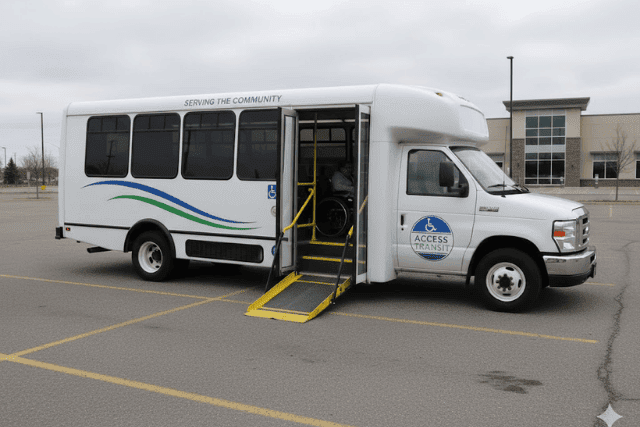
If you’re searching for the best wheelchair bus suppliers in Canada, you’re likely facing a real operational challenge, not just doing casual research.
- Maybe your current vehicle is unreliable.
- Maybe your program is growing.
- Maybe funding just came through, and you need to make the right decision the first time.
Here’s what most articles won’t tell you: There isn’t a single “best” wheelchair bus supplier in Canada. There’s only the best fit for your program’s size, routes, funding model, and long-term goals.
- Some manufacturers specialize in large transit fleets.
- Some focus on small community shuttles.
- Some build electric platforms.
- Others convert cutaway chassis for flexible layouts.
The risk isn’t choosing the wrong brand; it’s in choosing a vehicle type that doesn’t match how your organization actually operates.
In this guide, we’ll walk you through the major wheelchair bus manufacturers operating in Canada, when a wheelchair bus makes sense, and when a van may be the smarter investment.
Au MoveMobility, we’ve worked with community organizations, Indigenous groups, health agencies, and transit programs across Canada for more than 20 years. Our goal here isn’t to promote one option blindly; it’s to help you make a confident, informed decision based on how your team actually delivers service.
Let’s start by understanding how different manufacturers position themselves in the Canadian market.
Top 5 wheelchair bus manufacturers in Canada
If you’ve been researching wheelchair buses for a while, you’ve probably seen a lot of the same names pop up, but knowing which ones actually understand your needs is a whole different story. In this next section, we’ll walk you through five manufacturers in Canada who have proven experience building vehicles that support safety, comfort, and access.
Each one has something different to offer depending on your program’s size, region, and goals.
1. Crestline Coach Ltd.
Crestline Coach Ltd., based in Saskatoon, Saskatchewan, is one of Canada’s long-standing specialty vehicle manufacturers. Established in 1975, the company builds a range of vehicles including ambulances, commercial shuttles, and wheelchair-accessible buses.
Crestline’s wheelchair bus offerings are typically suited for organizations that require durable commercial-grade vehicles and national service coverage. Because of their scale and history in emergency and specialty vehicles, they are often considered by:
- Hospitals and healthcare networks
- Senior living operators
- Larger community transport programs
- Organizations seeking standardized fleet builds
Their buses can include lift systems, securement configurations, and seating layouts designed for mixed ambulatory and wheelchair passenger transport.
Considerations when evaluating Crestline:
- Vehicle size and operating cost compared to your daily passenger volume
- Licensing requirements for larger bus platforms
- Customization flexibility versus standardized fleet builds
- Availability of service support in your region
For programs that need commercial durability and nationwide presence, Crestline may be a suitable option. However, smaller community programs or rural operators may find that vehicle scale, fuel usage, or licensing requirements influence their final decision.
2. New Flyer (NFI Group)
New Flyer is based in Winnipeg, Manitoba. It is part of NFI Group, a large Canadian transit company. They build full-size buses used by public transit systems across the country.
If you ride a city bus in Canada, there is a good chance it came from New Flyer.
These buses are made for busy city routes. They run all day, every day. Most models include low floors, wide doors, and ramps. Some can lower closer to the ground to make boarding easier for people using wheelchairs.
New Flyer is usually considered by:
- City and regional transit agencies
- Large community shuttle programs
- Organizations moving many riders each day
- Fleets that need strict government compliance
Their vehicles meet transit safety and access rules. This matters for public funding and long-term fleet planning.
Things to think about before choosing New Flyer
- Bus size compared to how many people you move each trip
- Fuel, storage, and upkeep costs
- Driver’s licence needs for large buses
- Limited flexibility for smaller or custom programs
New Flyer works best for high-traffic routes and large fleets. For smaller teams, rural routes, or programs that need more flexibility, a full-size transit bus may be more than you need.
That is why many community programs look at other vehicle types before committing to a large wheelchair bus.
3. Girardin Minibus
Girardin Minibus is based in Drummondville, Quebec. They build small and mid-size buses used across Canada. Many of these buses are built on van or truck frames. People often call these cutaway buses.
Girardin also works with Blue Bird on the Micro Bird line. This includes school and community buses. Some models include wheelchair lifts and tie-downs.
Girardin is often considered by:
- Small towns and rural communities
- Senior programs and day programs
- School and shuttle services
- Outreach teams with short routes
These buses are easier to drive than full-size transit buses. They also cost less to buy and run. Most setups carry one or two wheelchairs plus seated riders.
Things to think about before choosing Girardin
- How many wheelchairs you need per trip
- Lift type and loading time
- Space inside the bus for staff and riders
- Service and warranty support near you
Girardin works well for programs that need a simple and smaller wheelchair bus. If your routes are short and your group size stays small, this style can make sense.
For programs that are growing fast or need more flexibility, other vehicle types may be worth a closer look.
4. GreenPower Motor Company
GreenPower Motor Company is based in Vancouver, British Columbia. They build fully electric buses. These are not conversions. They are designed as buses from the start.
Their vehicles are used for public transit, school routes, and community transport. Some models can carry several wheelchair users. Access comes from ramps or lifts.
Organizations that consider GreenPower include:
- City transit programs
- School boards and municipal fleets
- Organizations with clean energy goals
- Programs planning for long-term use
These buses meet strict safety and access rules. That matters for public funding and policy support.
Things to think about before choosing GreenPower
- Charging access at your depot or yard
- Range needs for daily routes
- Service and repair support near you
- Higher upfront cost compared to gas or diesel buses
Electric buses can lower fuel and repair costs over time. Still, they need planning. Charging, training, and route length all matter.
GreenPower can be a good fit for programs ready to go electric. If your routes are shorter and charging is in place, this option may work well.
5. Creative Carriage
Creative Carriage is based in Saint George, Ontario. The company has built and converted wheelchair accessible vehicles for more than 30 years. They offer low-floor shuttle buses and also supply wheelchair buses through partner manufacturers.
Some models, such as the Community Shuttle CS-1 and CS-2, are designed for easier boarding. These vehicles may include ramps, low floors, and space for two or more wheelchair users.
Creative Carriage is considered by:
- Community transport programs
- Rural and small-town services
- Support and care organizations
- Groups needing low-floor access
These vehicles follow Canadian safety rules, including CMVSS and CSA D409. This matters when transporting riders who need added support.
Things to think about before choosing Creative Carriage
- Passenger and wheelchair capacity needs
- Route length and road conditions
- Service and parts access near you
- Layout needs for mixed riders
Creative Carriage fits programs that want a low-floor shuttle without moving to a full transit bus. It is one option for smaller groups that need wheelchair access and simple layouts.
What if I’m still unsure about choosing a full-size wheelchair bus?
Let’s be honest: Wheelchair buses are a big investment. While they’re a great fit for many organizations, they’re not always the right answer for everyone.
Some programs are still growing and don’t need a large bus just yet. Others work in areas where narrow streets, long driveways, or rough gravel roads make it hard for a full-size wheelchair accessible bus to get around.
When deciding on a vehicle, remember that full-size buses cost more, use more fuel, and need more maintenance. They also often require a special driver’s licence, which can be tough if your team is small. That’s why so many of the people we work with are choosing wheelchair vans instead.
A van can still carry up to three wheelchairs, plus seated passengers. It’s easier to park, faster to load, and simpler to drive in busy city streets or winding rural roads. For some teams, vans feel like the perfect “middle ground” between a personal vehicle and a full-sized wheelchair accessible bus for sale.
What situations does a wheelchair van make more sense than a bus?
Here are a few real-world examples (based on clients we’ve worked with across Canada):
1. Small outreach teams in tight city spaces
Imagine a non-profit in downtown Halifax that provides transportation to community meals and medical clinics. They only move 2 to 3 people at a time. A large wheelchair bus would be hard to park and tough to maneuver through narrow, one-way streets. A rear-entry wheelchair van solves the problem, and drivers don’t need special training.
2. Long rural routes with limited stops
Picture a seniors’ program in Prince Edward County, Ontario, with one driver who visits homes across 100 km of rural road. They pick up one client in a wheelchair and one ambulatory rider at a time. A bus would use more fuel and be hard to justify for two riders. In this case, a side-entry wheelchair accessible van gets the job done comfortably.
3. New programs testing the waters
Say a health team in Fort St. John, BC, just launched a new program that supports wheelchair users who need help getting to rehab appointments. They’re still figuring out the demand and don’t want to commit to a $500K+ wheelchair bus for sale. A van lets them start small, collect data, and grow later if needed.
So, what should you choose?
It depends on your riders, your routes, and your goals. For some massive organizations with a hefty budget on hand, a wheelchair accessible bus is the right tool. But for others, especially those with fewer riders, different communities, and rural roads, a van brings more value with fewer complications.
And remember, the best wheelchair buses in Canada aren’t always the biggest ones; they’re the ones that actually fit what your community needs.
If you’re still unsure, don’t stress. We’ve helped hundreds of Canadian teams figure this out, and we’d be happy to talk through what might work best for you.
Need help deciding between a wheelchair van and a wheelchair bus?
You came here because you’re facing real challenges: Your current vehicles might not be doing the job for the people you serve. Maybe schedules slip up too often, costs balloon, or riders feel neglected.
What you learned after reading this article:
- The top wheelchair bus manufacturers in Canada, and what makes each one different.
- Scenarios where a smaller fourgon pour fauteuils roulants makes more sense than a full-size wheelchair bus for your program.
Au MoveMobility, we build and deliver wheelchair-accessible vehicles that solve these exact problems. We manufacture full‑size accessible vans in our Canadian facility in Winnipeg, offer more than 20 years of real experience, and hold the National Safety Mark on every modified vehicle.
Our work with Indigenous communities, health agencies, transit partners, and rural programs has taught us flexibility, durability, and service matters. We lead the industry because we design around your needs, not just off‑the‑shelf, but built for votre passengers, routes, and budget. If you have questions or want to see options, click the button below to talk to a mobility expert.
If you’re not ready to talk to a mobility expert yet, we have a few other resources you should check out to learn more. Scan the articles below to guide you toward making a confident decision:
- How to choose a wheelchair van (11 steps): This guide will help you find what to look for so your van or bus works safely, comfortably, and lasts longer.
- What kind of licence do you need to drive a wheelchair van in Canada? After reading this, you’ll know all about licensing when it comes to driving a wheelchair van in Canada.



 English
  French