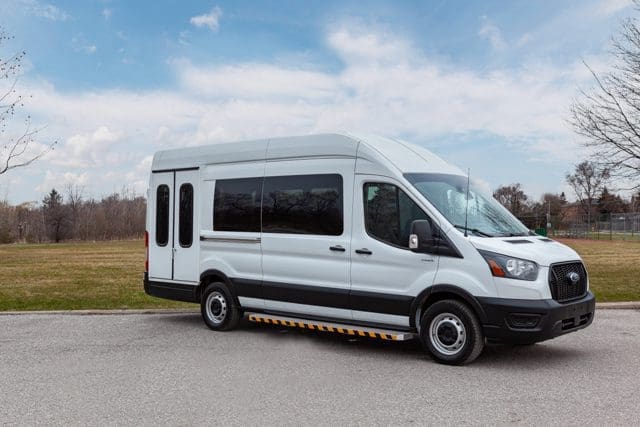
A wheelchair accessible minibus can sound like the right fit at first. Then reality sets in. You may worry it’s too large for your routes, too expensive to operate, or too hard for staff to drive through downtown streets, icy roads, or crowded parking lots. That concern is real. In Canada, almost 30% of people with disabilities have avoided travel because of accessibility barriers, and 17.8% report being housebound because they cannot access specialized transportation.
For adult day programs in Ontario, First Nations communities in Northern Manitoba, or transit groups in small towns across Alberta, choosing a wheelchair accessible minibus that’s too large can create new problems instead of solving them.
At MoveMobility, we’ve spent more than 20 years helping Canadian organizations reduce barriers to transportation and care. Over the past three years alone, we’ve built more than 480 wheelchair vans and 180 mobile medical units. We’re a certified Ford Pro Upfitter, hold Stellantis QPro certification, and every vehicle carries the National Safety Mark. We’ve worked with groups like Transdev, and we’re proud recipients of the DARE Innovation Award.
In this article, you’ll learn:
- If a wheelchair accessible minibus may be too large for your organization
- Why smaller options can be easier to run and easier to fill
- How the P4 and T6 compare as wheelchair minibus alternatives
Is a wheelchair accessible minibus right for your organization?
A wheelchair accessible minibus can make sense for some organizations. If you need to transport 12, 14, or even 16 passengers at once, a larger vehicle may be the best fit. Many transit agencies, retirement homes, and larger day programs use a wheelchair minibus because they need the extra seats every day.
Still, a bigger vehicle can create challenges that are easy to overlook at first.
A wheelchair accessible minibus often comes with:
- Higher fuel costs
- More maintenance costs over time
- A larger turning radius
- More difficulty parking in tight spaces
- Higher insurance costs
- Extra driver training requirements in some provinces
- The pressure to fill seats to make each trip feel worthwhile
For example, imagine you run an adult day program in downtown Toronto. Most days, you transport two wheelchair users and three other passengers. A full-size wheelchair accessible minibus may give you more seats than you actually use. That can leave you paying for extra space, higher fuel use, and more stress for your drivers when they need to navigate narrow streets or busy parking lots.
The same thing can happen in rural communities. A First Nations health team in Northern Ontario may need to drive long distances on winter roads. A smaller vehicle can feel easier to drive, easier to park, and less intimidating for staff who are not used to operating a larger wheelchair minibus.
- Ask yourself: How many people do you usually transport at one time?
- Ask yourself: How often are all the seats full?
- Ask yourself: Will your staff feel comfortable driving a larger vehicle every day?
If those questions make you pause, a smaller option may be a better fit.
Should I consider an alternative to a wheelchair accessible minibus?
For many organizations, the goal is not to carry as many passengers as possible. The goal is to transport the right number of people safely, comfortably, and without making every trip feel harder than it needs to be.
If you usually transport:
- Fewer than 10 ambulatory passengers
- One to three wheelchair users
- Smaller groups for shorter local trips
- Riders at different times throughout the day, instead of all at once
Then a smaller wheelchair minibus may make more sense.
A large wheelchair accessible minibus for sale can leave you paying for seats that sit empty most days. It can also create more stress for drivers, especially in places with tight streets, small parking lots, winter roads, or heavy traffic.
For example, a seniors’ program in Halifax may only transport four or five people at a time. A community group in Saskatchewan may use a vehicle for shorter trips between nearby towns. In both cases, a smaller wheelchair accessible minibus can feel easier to drive, easier to park, and easier to fill.
That matters because empty seats cost money. Larger vehicles often come with higher fuel use, more maintenance, and more wear over time.
When your vehicle size matches your actual ridership, every trip can feel simpler, more efficient, and less stressful for both staff and passengers.
What wheelchair accessible minibus alternatives are there?
If a full wheelchair accessible minibus feels too large for your routes, there are smaller options that can still carry both ambulatory and wheelchair passengers comfortably. One of the most popular choices for organisations across Canada is the P4 Ram ProMaster accessible van.
The P4 wheelchair van: Flexibility without the size
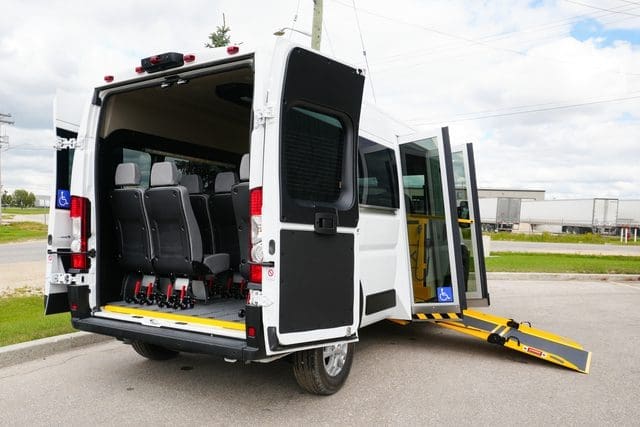
The P4 is built on the RAM ProMaster 159-inch wheelbase high roof chassis. Many organizations choose it when they want to move away from a large cutaway bus and into something easier to drive, easier to park, and easier to use every day.
As we mentioned earlier, a full-size wheelchair minibus can feel like too much of a vehicle for smaller groups. The P4 gives you many of the same benefits in a smaller package.
The P4 can carry:
- Up to 10 ambulatory passengers
- Up to 3 wheelchairs
- A mix of wheelchair users and ambulatory passengers
That flexibility can make a big difference if your passenger counts change throughout the day.
For example, a seniors’ transportation program in Winnipeg may have one route in the morning with two wheelchair users and three other passengers. Later in the day, they may only transport six ambulatory passengers. A larger wheelchair accessible minibus for sale may feel too big for those trips, while the P4 gives you more flexibility without carrying extra unused space.
The P4 is easy to drive
One of the biggest reasons organizations choose the P4 is because it feels more approachable for drivers.
Large buses can feel intimidating. Tight parking lots, narrow residential streets, snow-covered roads, and busy downtown traffic can make a larger vehicle stressful to drive. The P4 has a smaller footprint, which can help staff feel more comfortable behind the wheel.
Some key features include:
- Front-wheel drive for strong traction on snow and ice
- High ground clearance without a lowered floor
- A backup camera for easier reversing
- Fuel mileage of around 21 mpg
- A 3.6L Pentastar V6 engine
- No additional driver licensing requirements in many provinces
That last point matters more than many people think. A larger wheelchair accessible minibus may require extra licensing depending on passenger count and province. The P4 often avoids that issue, which can make hiring and training drivers much easier.
The P4 can help passengers feel more comfortable
The P4 is available with side-entry or rear-entry ramp access.
Many organizations prefer the side-entry option because wheelchair users and ambulatory passengers enter through the same door. That can create a more welcoming and inclusive experience.
In larger buses, wheelchair users often enter separately through a rear lift. That process can feel slower and more isolating. The side-entry P4 uses a powered ramp and bus-style doors, which can make loading faster and less stressful.
Some benefits of side-entry access include:
- Faster loading and unloading
- One shared entrance for all passengers
- Less waiting during busy routes
- A more comfortable experience for wheelchair users
- More space around the doorway
For a First Nations community transportation program or an adult day centre in Ontario, that smoother boarding experience can help riders feel more relaxed and respected before the trip even starts.
The P4 is also CMVSS and D409 certified, which means it meets Canadian safety standards for accessible transportation. That can give your staff, passengers, and families extra peace of mind when they step on board.
The Ford Transit T6: Bus functionality without the size
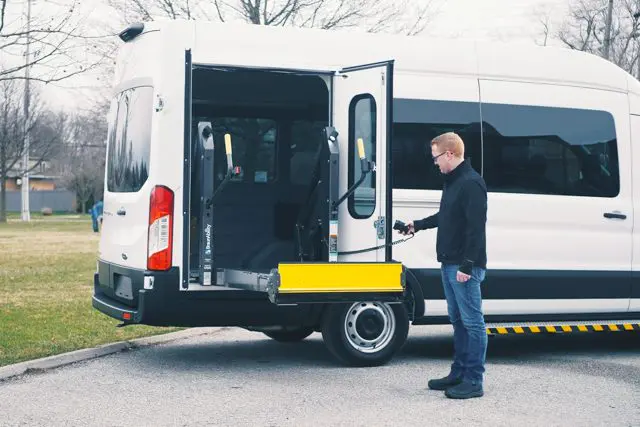
If you like the idea of a wheelchair accessible minibus but still want something smaller and easier to manage, the Ford Transit T6 can be a strong option.
The T6 is built on the Ford Transit 148-inch extended-wheelbase high-roof chassis. It gives you many of the same features as a larger bus, but with the flexibility and lower operating costs of a van.
For organizations that want clear separation between ambulatory and wheelchair passengers, the T6 can feel more like a traditional bus while still being easier to drive.
The T6 keeps the feel of a bus in a smaller package
One of the biggest differences between the T6 and the P4 is how passengers enter the vehicle.
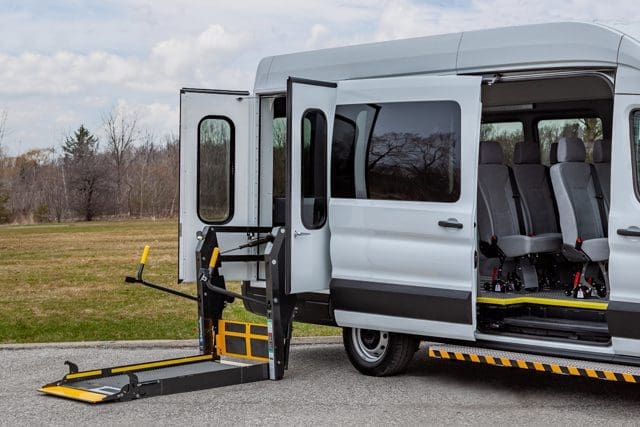
The T6 features a side-entry step for ambulatory passengers and a rear curbside lift for wheelchair users. That layout can feel familiar for organizations already using larger transit buses or cutaway buses.
The T6 includes:
- Bus-style dual-leaf doors
- A side walk-on entry step
- A rear BraunAbility powered lift
- Space for large wheelchairs and scooters
- Room for bariatric mobility devices
- Full driver visibility throughout the cabin
For example, if you operate a long-term care facility in British Columbia, you may regularly transport passengers who use larger power chairs or scooters. A standard wheelchair accessible minibus may not always provide enough room. The T6 is designed to handle larger mobility devices more comfortably.
That can make a major difference for care teams who need to support people with a wider range of mobility needs.
The T6 is be easier for staff to drive every day
Like the P4, the T6 keeps the driving feel closer to a van than a bus. That can help reduce driver stress, especially in urban areas, tight parking lots, and winter driving conditions.
The T6 offers:
- Rear-wheel drive
- Available all-wheel drive
- A non-modified chassis for added durability
- Better maneuverability than a larger bus
- Strong visibility for the driver
- Lower maintenance needs than many larger buses
That non-modified chassis is important because it helps keep the original Ford design intact. Some larger accessible vehicles require major frame changes or lowered floors. The T6 keeps more of the original vehicle structure, which can help with long-term durability and serviceability.
For organizations in places like Northern Alberta or rural Saskatchewan, having all-wheel drive can also add extra confidence during winter travel.
The T6 is built for larger wheelchairs and safer loading
One area where the T6 stands out is wheelchair access.
The heavy-duty BraunAbility lift is built to handle larger mobility devices, including bariatric chairs and scooters, often used in supportive living facilities or long-term care settings.
The lift features:
- A 34-inch by 51-inch platform
- An 800-pound lift capacity
- Quiet folding and unfolding
- Stable operation during loading
- Direct curbside access
That curbside access can make loading safer because wheelchair users board from the sidewalk side of the vehicle instead of closer to traffic.
Inside the T6, wheelchair positions use four-point restraint systems, lap belts, and shoulder harnesses to help keep passengers secure during travel.
The wheelchair securement system is:
- Compatible with the AutoFloor track system
- Easy to reconfigure as your passenger mix changes
- Self-tensioning for quicker use
- Tested to Canadian safety standards
For a healthcare organization, community living group, or seniors’ transportation provider, those details can help make daily trips smoother for both passengers and staff.
The T6 gives you a bus-like layout, larger wheelchair capacity, and strong safety features without moving all the way up to a full wheelchair accessible minibus.
Got any questions about finding the right wheelchair bus alternative?
You came to this article because a wheelchair accessible minibus may have felt too large, too expensive, or too difficult for your team to use every day. You wanted something that still supports your passengers well without creating extra stress for your drivers, staff, and budget.
After reading this article, you now know:
- A wheelchair accessible minibus is not always the best fit for smaller groups.
- The P4 can be a strong option if you want flexibility, easier driving, and shared side entry access.
- The T6 can make sense if you want more of a bus feel and need space for larger wheelchairs or scooters.
- Smaller vehicles can still support accessibility, dignity, and comfort without unused seats and higher costs.
Our team at MoveMobility has spent well over two decades helping organizations across Canada find the right fit for their transportation programs. We’ve supported adult day centres, transit agencies, seniors’ programs, and First Nations communities with solutions built around their actual passenger needs, routes, and staff comfort levels.
We’ve partnered with organizations like Loft and Yellowknife Women’s Society because we know every community has different barriers to solve. At the end of the day, our goal is simple. We want to help you find a vehicle that makes life easier for the people you serve and the people who drive it every day. If you have questions, click the button below to talk to a mobility expert.
What should you read next?
- Full size wheelchair van or minivan: Which is right for you? This article can further help you compare another smaller option, the minivan, to regular wheelchair vans.
- What is the P4 3-in-1 van from MoveMobility? This article takes a look at the P4 3-in-1 and can help you understand how it works for mixed passenger groups.
- Wheelchair van vs. Bus: Everything you need to know! This article takes another detailed look at wheelchair vans and buses to help you compare the larger bus experience with smaller van-based options before making a final decision.


 English
  French