

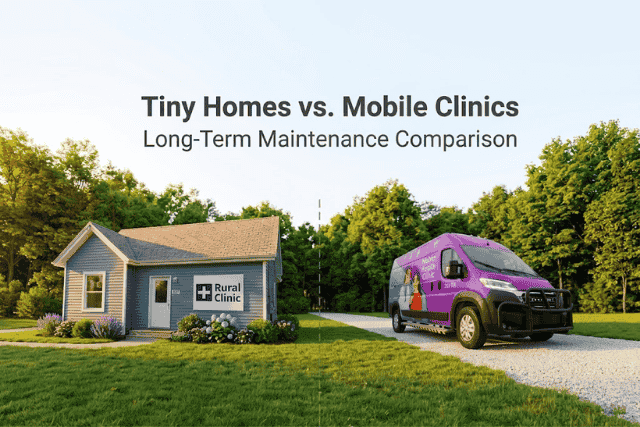
Did you know that about five million Canadians do not have a regular primary care doctor? It’s a big weight to carry when you’re the one trying to fix it. You might feel stuck because people in your target communities in places like rural Alberta or the outskirts of Toronto can’t get to a doctor. If you don’t find a way to reach them, their health gets worse, and they feel forgotten.
It’s hard to see people suffer when you know a better setup could help. You want to offer a space that feels like home and gives them dignity. You’re looking for a way to close the gap between your care and the people who need it. Mobile clinics and tiny homes both seem like viable options to bring health right to their community.
At MoveMobility, we’ve spent over 20 years listening to people like you. We’ve built more than 150 mobile medical units to help organizations reach every corner of the country. We’ve partnered with organizations like Liard First Nation to make sure healthcare gets to where it’s needed. Our team holds Ford Pro Upfitter and Stellantis QPro certifications. We also have the National Safety Mark to show our vehicles are safe for your team. We know we aren’t the only ones making these tools, and we want to be fair as you weigh your choices.
This article helps you compare tiny homes and mobile health clinic options. You’ll see which one fits your specific goals best.
We’ll look at:
- Cost differences for your budget
- How easy it is to move around
- Maintenance and long-term care
What exactly are mobile clinics and tiny homes?
Before we dive deep into the details, it’s helpful to understand what we mean by these two choices. Both are tools meant to help people, but they work in very different ways. You might be feeling a bit overwhelmed by all the options out there. It’s okay to take a breath and look at the basics first. You want to make sure the choice you make fits the unique heart and soul of your community.
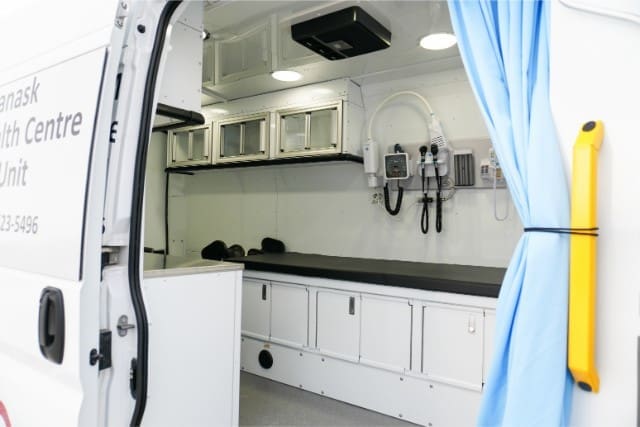
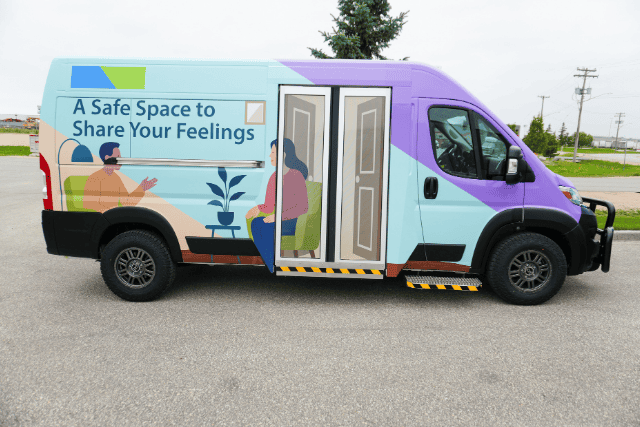
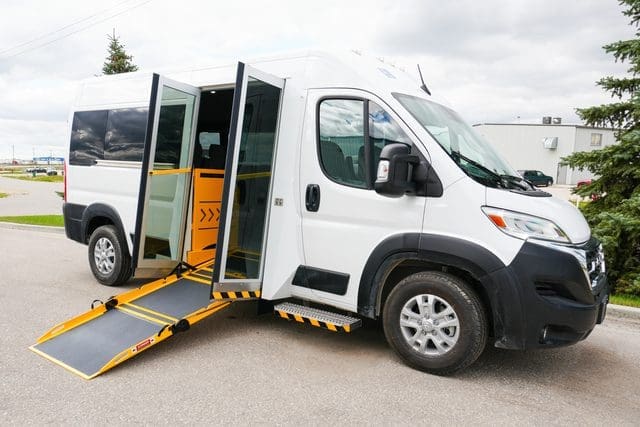
Mobile clinics are specialized vehicles, like a large van, RV, or bus, that have been turned into a doctor’s office on wheels. They are self-contained, which means they carry their own power, water, and heat. You don’t need to plug them into a building to start helping people. These units are designed to move every single day. They bring things like check-ups, vaccines, and mental health support directly to the sidewalk or a local park.
Tiny homes are small, permanent or semi-permanent buildings. In a healthcare setting, they are often used as a “static” clinic. They look like a very small house and offer a cozy, private space for patients. While some tiny homes are built on trailers, they are usually meant to stay in one spot for a long time. They often need to be hooked up to local electricity and water lines to function properly.
What are they best for?
- Mobile medical units: Best for moving between many different locations and reaching people who can’t travel.
- Tiny home clinics: Best for staying in one specific neighborhood to provide a consistent, home-like feel.
Now that we know what they are, let’s jump into how the costs compare so you can see which one fits your budget.
What are the cost differences between tiny homes and mobile clinics?
When you’re trying to choose the best way to help your community, money is a huge part of the puzzle. You want every dollar to go toward saving lives and making people feel better. It’s stressful to look at a big price tag and wonder if you’re making the right move for your organization.
You might be worried that picking the cheaper-looking option now will cost you way more down the road. It’s a lot of pressure to balance a budget while trying to provide high-quality care to people in places like remote Northern Ontario or the busy streets of Vancouver.
Let’s look at the numbers for mobile clinics first. Usually, a high-quality mobile health clinic costs between $205,000 to $315,000. That might seem like a lot at first glance, but it’s important to know what you’re getting. This price reflects a Mobile Clinic Van that is already built to meet strict safety rules. It’s ready to hit the road and start helping people almost immediately. You’re buying a complete mobile medical unit that can travel wherever the need is greatest.
What about tiny homes?
At first, a tiny home might look like it saves you money. You can find basic shells for under $100,000, but that is rarely the final price for a medical space. Since you’re using this for healthcare, you can’t just buy a standard backyard cabin. You need a space that is clean, safe, and tough enough for Canadian winters. By the time you add medical-grade floors, professional lighting, and workstations, the build price alone often climbs to between $150,000 and $250,000.
The biggest gap in the cost of a tiny home isn’t the building itself. It’s everything else you have to pay for to make it work. Unlike mobile medical clinics that carry everything they need, a tiny home is usually stuck in one spot. This means you have to deal with land and utilities, which can quickly push your total investment well over $400,000 in many parts of Canada.
- Land and rent: Unless you already own a perfect piece of property, you’ll have to buy or rent it. In parts of BC or Ontario, buying even a small lot can cost $150,000 or more.
- Utility hookups: With a mobile health unit, you can plug into shore power outlets or use a generator for power. Getting a tiny home connected to the local grid or setting up a septic system can cost between $10,000 and $60,000, depending on how far you are from city lines.
- Permits and taxes: Every town has different rules. You might spend thousands on building permits, rezoning, and development charges before you even open your doors.
Comparing the total investment
When you add it all up, the tiny home that initially looked cheaper can end up costing much more than mobile health clinics. With a tiny home, you’re often paying for property that your organization doesn’t even own if you’re leasing the land. Plus, if the community’s needs change and you need to move, you can’t just drive a tiny home to the next town easily. You might have to leave all that expensive utility work behind and start over somewhere else.
| Cost item | Mobile clinics | Tiny homes (medical grade) |
| Initial build | $205,000 to $315,000 | $150,000 – $250,000 |
| Land costs | $0 (Park and go) | $50,000 – $200,000+ |
| Hookup fees | $0 (Self-contained) | $10,000 – $60,000 |
| Permits & setup | Vehicle registration | $5,000 – $15,000+ |
Choosing mobile medical vehicles means your money goes directly into the care you provide, not into the ground. It removes the barrier of permanent construction and lets you focus on your mission. Now that we’ve looked at the money, let’s talk about how easy it is to actually get these units to the people who need them.
How does mobility differ between tiny homes and mobile clinics?
Being able to move from one place to the next is everything when you’re trying to reach people who live far away from a hospital. You might feel a heavy sense of frustration when you know there are people in a nearby town or a remote camp who need help, but you’re stuck in one place.
It’s hard to watch a community go without care just because the clinic can’t get to them, and vice versa. You want to be where the need is, whether that’s a downtown street corner on Monday or a rural park on Tuesday. This is where the choice between a tiny home and mobile clinics really shows its impact on your daily work.
The biggest strength of mobile clinics is right there in the name: mobility. These are built into vehicles like the Ford Transit or Ram ProMaster. You can hop into your mobile medical van and drive literally anywhere a road takes you. There is no special equipment needed and no long setup process.
If you can drive a regular car, you can usually drive these mobile medical vehicles. This freedom lets you follow the people you serve. If a neighborhood in Winnipeg needs flu shots this morning, you’re there. If a community event in a different part of the city needs health screenings in the afternoon, you just turn the key and go.
Moving a tiny home is a major project
You might see tiny homes and think they are just as easy to move. While some can be moved, they aren’t meant for daily travel. In fact, most tiny homes are built to be moved once or twice a year at most. They are heavy, tall, and wide, which makes them very tricky to navigate on Canadian roads. Moving one feels less like a quick trip and more like a massive construction project.
- Special tow vehicles: You can’t pull a medical tiny home with a regular SUV. You often need a heavy-duty truck, like a one-ton dually, which can cost your organization another $80,000 to $100,000.
- Towing permits: Because tiny homes are so big, many provinces have strict rules. You might need special oversize load permits just to move it from one town to the next.
- Driver experience: Most staff find driving a mobile medical clinic easy. Towing a 15,000-pound tiny home is dangerous if you aren’t trained. This means you might have to hire a professional towing company every time you want to move.
Setting up and packing down for care
The gap in mobility also shows up in how much time your team spends working versus how much time they spend setting up. With mobile health solutions, your clinic is ready to go the moment you put it in park. All your equipment stays safely in place. With a tiny home, every move involves a lot of extra work that can take away from patient time.
- Stabilizing the unit: A tiny home needs to be leveled and stabilized on jacks every time it moves so it doesn’t wobble while a doctor is seeing a patient.
- Connecting services: Every time you move a tiny home, you have to unhook and re-hook water, power, and waste lines. A mobile medical unit has these systems built in and ready to use.
- Interior safety: Items in a tiny home aren’t always bolted down. You have to pack up your medical supplies so they don’t break during the bumpy ride. In a mobile health van, everything has a secure spot.
Reaching the most remote locations
If your goal is to help people in the most rugged parts of Canada, like the mountains of BC or the gravel roads of the North, a mobile health vehicle is usually the better partner. Tiny homes are often too tall to fit under low bridges or too heavy for soft dirt roads.
When you choose a mobile medical clinic, you’re choosing to remove the barrier of distance. You’re giving your team the power to say “yes” whenever a community calls for help. You won’t be held back by towing hitches or land permits. You’ll just be out there, where the patients are, providing the care they deserve. Now that we’ve talked about getting there, let’s look at what the maintenance and long-term care of these options looks like.
How do maintenance and long-term care compare between tiny homes vs. mobile clinics?
Taking care of your clinic is just as important as taking care of your patients. You want to feel confident that your space is safe and ready every single morning. It’s a stressful feeling when you’re worried about a pipe bursting in the middle of a cold January night or a vehicle not starting when a community is waiting for you.
You want a solution that lets you spend more time with people and less time with a toolkit. Both mobile clinics and tiny homes need regular love, but the kind of work you’ll do is quite different.
With mobile medical clinics, maintenance is mostly about keeping a vehicle healthy. Since these are high-quality vans, you follow a schedule similar to that of a regular car. You’ll need oil changes, tire rotations, and brake checks. Because you’re operating in Canada, you also have to think about the winter basics.
- Vehicle health: You’ll need to check your battery and maybe use a block heater to keep the engine warm on frozen mornings.
- Specialized systems: Your mobile health clinic has an onboard generator and HVAC systems that need a professional eye once or twice a year to keep the air clean and the power flowing.
- Road salt: Canadian winters mean salt on the roads, so regular undercarriage washes are a must to stop rust before it starts.
The heavy lifting of tiny home upkeep
Maintenance for a tiny home is more like looking after a small house. Since it remains in one spot, it’s constantly fighting the elements. This can create a gap in your schedule because house repairs often take longer than a quick trip to a mechanic. If your tiny home clinic has a leak or a power issue, you might have to wait for a specialized plumber or electrician to drive out to your site.
- Foundation and skirting: You have to check that the ground hasn’t shifted and that your skirting (the panels around the bottom) is tight to keep out cold air and pests.
- Roof and gutters: Snow buildup is a big deal in Canada. You’ll need to clear the roof and keep gutters clean, so ice dams don’t damage your walls.
- External hookups: Since tiny homes often use hoses or wires running from a main building, these are prone to freezing or tripping hazards if they aren’t buried deep enough.
Comparing long-term care needs
In the long run, mobile health solutions are built for the wear and tear of the road. They’re designed to be shaken as they drive, so the cabinets and medical tools are bolted down tight. Tiny homes aren’t always built for movement, so if you do move them, you might find cracks in the drywall or loose plumbing.
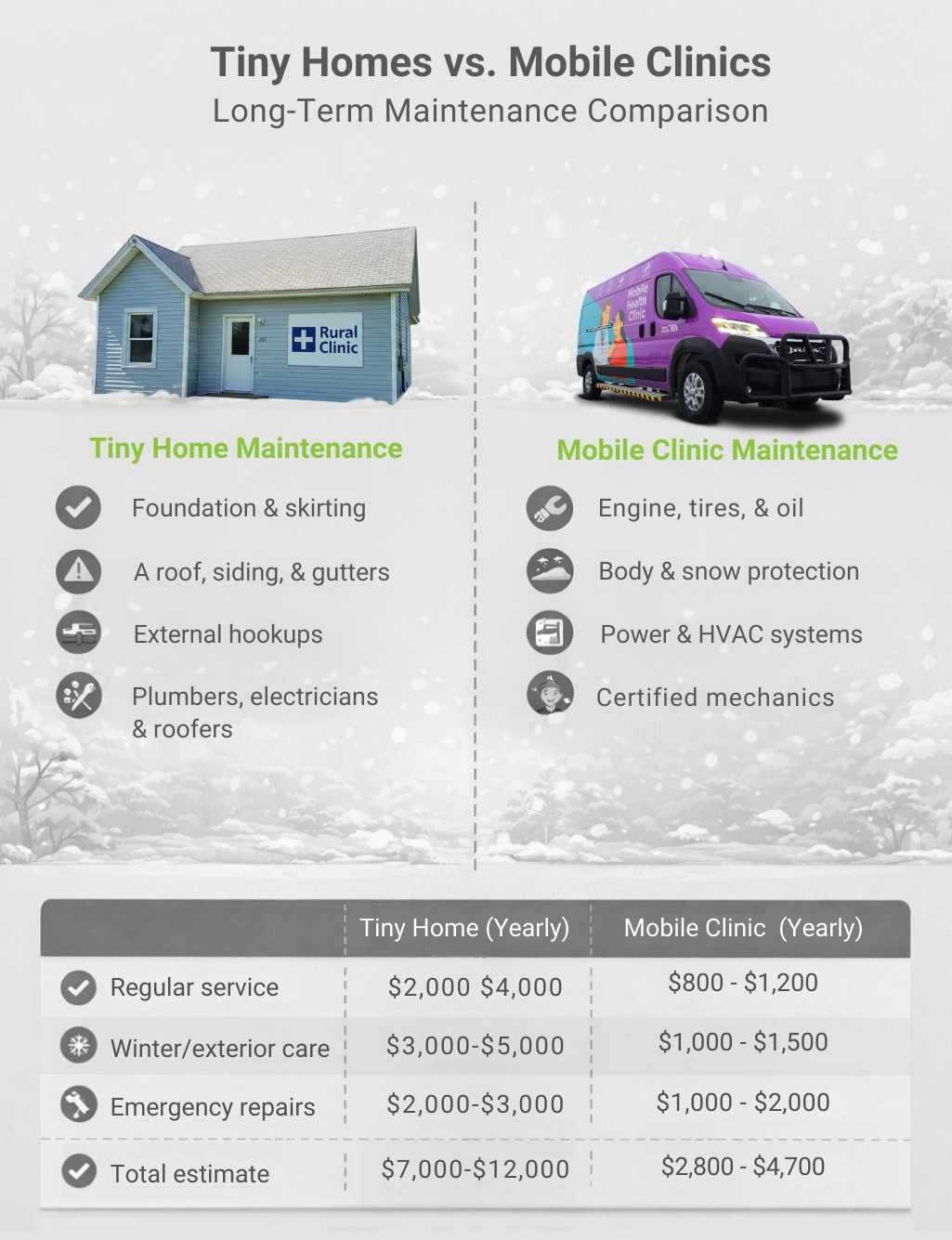
| Maintenance task | Mobile clinics | Tiny homes |
| Mechanical | Engine, tires, and oil | None (unless towing) |
| Structural | Vehicle body checks | Roof, siding, and foundation |
| Winter care | Winter tires & block heaters | Pipe insulation & snow removal |
| Who fixes it? | Certified mechanics | Plumbers, electricians, & roofers |
Looking at the long-term maintenance numbers
When you look at the total cost of ownership, the gap between these two options gets wider. Mobile clinics are designed to be efficient. Tiny homes are often built with standard house parts that aren’t meant for heavy medical use. Over five years, the extra money you spend on a tiny home could have been used to hire more staff or help more families.
Which option should you choose: a tiny home or a mobile clinic?
Deciding between a tiny home and mobile medical units is a big moment for your team. You want to pick the path that helps the most people with the most dignity. It’s okay to feel a bit stuck as you weigh these paths.
- Think about your location: If you have one fixed spot and own the land, a tiny home can work. But if your patients are spread out, mobile clinics are the best choice.
- Check your daily travel: Do you need to visit three towns in a week? A mobile clinic van lets you do that easily. A tiny home is meant to stay put for a long time.
- Look at your budget: Mobile health solutions often save you money on land and setup fees. This means more funds go directly to mobile healthcare for those who need it.
- Consider your staff: If your team wants to drive themselves, mobile medical vehicles are simple to use. Moving a tiny home usually requires hiring professional help and a heavy truck.
Choosing mobile medical clinics removes the barrier of distance. It lets you bring a sense of hope right to a person’s driveway. If you want to move fast and reach many, mobile health is likely your answer. Imagine a day when no one in your region feels ignored. You arrive in your mobile health unit, and the relief on their faces is real. Both options help you save lives. Your choice depends on how you want to reach the people who count on you for mobile medical care.
Got any questions about choosing between a tiny home or a mobile clinic?
You probably started reading this because you want to bring health and hope to people who can’t reach a doctor. You’re trying to choose the best tool to close the gap between your care and your neighbours who feel forgotten.
- The total cost: You learned that mobile units often save you more money on land and setup than tiny homes.
- The freedom to move: You saw how vans give you the power to go wherever the need is greatest.
Our team focuses on building relationships so we can truly understand the barriers your community faces. We build spaces where dignity and healing can happen on every street corner. We’ve spent over two decades perfecting our designs because we know that a reliable van means a life-saving visit for someone in need. We’re proud to be leaders who help you do the hard work of caring for others. If you have any questions at all, please click the button below to talk to a mobility expert.
If you’re not ready to talk to a mobility expert yet, we have a few other resources you should check out to learn more.
Recommended next reads
- Mobile medical vans vs. mobile medical buses: This article helps you decide whether a smaller van or a larger bus is the right size for your team and patients.
- Why doesn’t MoveMobility manufacture mobile medical buses? Read this to understand why we focus on nimble vans and how that choice helps organizations stay flexible.
- Mobile medical RV vs. mobile medical Van: Which should you choose? This article compares two popular ways to take your medical services on the road to see which fits your team’s style.

 English
  French