

Did you catch the CBC story about ER closures in rural Manitoba? Hospitals across Canada are cutting back emergency room services because there are not enough doctors, nurses, or beds to handle the demand. Patients are waiting for hours, sometimes being told to drive even farther to another hospital. You know how that feels. Your ER is packed, your staff is running on fumes, and you are worried about the care your community is getting. If the gap is left alone, patients suffer, and your team risks burning out.
At MoveMobility, we work with healthcare networks like yours and Quest Community Health Centre to create mobile clinic solutions that remove barriers to care. We take time to understand your program, your patients, and your goals because every community is different. While we build vehicles for your needs, we know we are not the only manufacturer out there. What matters most is that you find the right fit for your team and the people you serve.
In this article, you will learn how a mobile clinic can support emergency room service shortages by:
- Adding capacity: Bringing urgent care closer to patients
- Reducing strain: Supporting busy ER staff
- Improving access: Keeping care local and timely
Roblin’s ER service shortage highlights why mobile clinics matter in Canada
If you want a clear example of how fragile emergency room service shortages can be in rural Canada, look no further than Roblin, Manitoba. In September 2020, Premier Wab Kinew, then the leader of the opposition, stood alongside residents at a healthcare rally in Roblin, who were frustrated by a shortage of hospital staff. People were asking for the provincial government to step in and fix the staffing crisis that had left their hospital struggling.
Fast forward a few years, and the challenge hasn’t ended. Roblin’s hospital is once again facing gaps in ER coverage. The reason is simple: there’s only one doctor in the community. When that doctor takes time off, the emergency room closes.
Sean Keeler, President of the Roblin Clinic Board, explained how residents feel:
“One thing he kind of said was what I took out is that no communities like Roblin will not be forgotten. And right now we’re feeling a little bit forgotten.”
It’s a situation that’s not unique to Roblin. Towns like Carberry, Manitoba, have also dealt with temporary ER closures. In 2023, Carberry’s ER was shut down indefinitely because there weren’t enough doctors. It took persistent advocacy from local leaders, cooperation with Prairie Mountain Health, and support from the province to eventually recruit two full-time physicians.
Mayor Ray Muirhead of Carberry shared:
“And ultimately we ended up with two full-time doctors, so we are in a, I would say, a good spot right now. It’s never perfect, it’s never as optimum as what we would like.”
The good news is Carberry’s ER is now running again. But the reality is that this success took time, effort, and a lot of coordination.
How can mobile clinics fill the emergency room service shortage gap?
This is where mobile clinics can play a big role. When ER service is suspended, communities are left in a dangerous gap:
- People still have medical needs
- Accidents still happen
- Chronic conditions still flare up
A mobile medical unit can help cover that gap by providing urgent primary care, triage services, and diagnostics while the ER is offline.
In rural Manitoba, that could mean setting up a mobile medical van in Roblin during periods of coverage gaps, giving residents a place to seek care without traveling hours to Dauphin or Swan River. These mobile health solutions don’t replace a full emergency room, but they keep care local, reduce risk, and ease the pressure on nearby hospitals.
Roblin’s situation is a clear reminder: staffing challenges won’t vanish overnight, and the time between now and a permanent solution can leave communities exposed. Mobile health units offer a practical bridge that keeps patients safer and communities healthier until long-term staffing is in place.
How can mobile clinics be deployed during emergency room service shortages across Canada?
When an emergency room closes, people still need care. Heart problems, injuries, infections, and other urgent health issues don’t pause just because the ER is short-staffed. This is where a mobile clinic can step in and help.
A mobile medical unit works like a clinic on wheels. It’s not meant to replace a full hospital, but it can keep basic care going while the ER is unavailable. The goal is to keep treatment close to home and reduce the load on the next nearest hospital.
Here are a few ways this could look in different parts of Canada:
Northern Ontario
- Rotating care: A mobile health clinic could travel between smaller towns during peak times like holidays or flu season.
- Onboard services: Wound care, triage, and urgent prescriptions could be handled on-site instead of sending everyone to Thunder Bay or Sudbury.
Rural Saskatchewan
- Local backup: When a town’s ER is closed, a mobile health unit could be set up outside the local hospital.
- Stabilizing patients: The clinic could provide immediate care, then transfer only serious cases to Saskatoon.
Atlantic Canada
- Community access: In remote parts of Newfoundland and Labrador, a mobile clinic van could park at a community center when ER coverage is low.
- Weather-friendly care: Residents could get urgent care, lab work, and even virtual visits with doctors in St. John’s without long, risky drives.
British Columbia’s Interior
- Wildfire seasons: Communities like Lillooet or 100 Mile House often face ER staffing gaps during busy summer months. A mobile health unit could be stationed at evacuation centers or community hubs to provide urgent care and chronic condition support when travel is disrupted.
Prairie farming communities (Alberta and Manitoba)
- Harvest season surges: Towns like Wainwright, AB, or Neepawa, MB, see more farm-related injuries during peak seasons. A mobile clinic van could help with triage, basic injury care, and reduce the strain on smaller ERs already stretched thin.
Northern Territories
- Remote outreach: In smaller communities like Fort Smith (NWT) or Arviat (Nunavut), travel to the nearest hospital can take hours or even require flights. A mobile medical unit could rotate between communities to fill coverage gaps, especially when short-term ER closures occur.
What’s inside a mobile medical clinic?
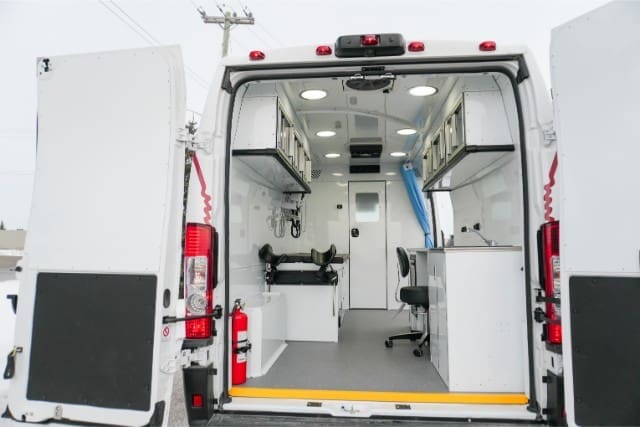
Mobile medical clinics are carefully designed workspaces built to make care easier for your team and more comfortable for your patients. Everything inside has a purpose, especially when your ER is short-staffed and you need every tool working for you.
Here’s a look at what you’ll typically find inside a mobile health unit:
| Feature | How it helps |
| Floor-to-ceiling cabinetry | Keeps supplies organized and within reach so you’re not wasting time searching for equipment. |
| Patient bed with under-bed storage | Offers comfort for the patient while doubling as extra space for essential supplies. |
| Power supply | Lets you run medical equipment, lights, and tech without relying on outside power sources. |
| Office desk with rolling chair | Creates a dedicated space for documentation, telehealth calls, or consultations. |
| Options for sink and fridge | Supports basic procedures, handwashing, and storing temperature-sensitive supplies or samples. |
| Rear heat and air conditioning | Keeps the environment comfortable for patients and staff in all seasons. |
| Trail Edition package (optional) | Boosts suspension and durability for rural or rough terrain travel. |
| Remote start (optional) | Saves time and helps maintain interior comfort in extreme weather. |
| Advanced medical equipment (optional) | Can be added based on your program needs, from diagnostic tools to treatment devices. |
| Awning (optional) | Creates a sheltered space outside the van for triage or patient intake. |
| HVAC system (optional) | Maintains consistent airflow and air quality, which is key for patient comfort and infection control. |
| Starlink for internet connectivity (optional) | Enables telehealth, secure data transfer, and real-time communication with other facilities. |
| Security system (optional) | Keeps equipment, medications, and patient records safe. |
With the right setup, a mobile medical van can function as an effective mini-clinic. It’s a flexible space that supports your team in delivering care where it’s needed and helps patients feel seen, even when the main ER is unavailable.
Ready to bridge emergency room service shortages with a mobile clinic?
You came to this article because emergency room service shortages are putting strain on your team and limiting patient care. ER closures, like what we saw in Roblin, create real gaps that put communities at risk.
After reading this article, you now know how:
- Mobile clinics can step in when ER coverage is suspended
- Features and capabilities of a mobile medical unit support urgent and routine care
- Deployment strategies work across regions in Canada
At MoveMobility, we’ve partnered with healthcare networks and community leaders from coast to coast to build vehicles that keep care moving during times of crisis. We don’t just build a van and send you on your way. We work with your team from the planning stage, through customization, and long after the keys are handed over. We’re trusted because we listen, build for your needs, and follow through. This is what has made us a leader in mobile health solutions.
If you have questions about how a mobile medical van could help your program, click the button below to talk to a mobility expert.
If you’re not ready to talk to a mobility expert yet, here are three helpful next articles to guide you:
- How do you fundraise for a mobile medical van?: Learn about some fundraising strategies to get your mobile clinic off the ground.
- How can you maximize space in your medical van? Worried mobile clinic vans don’t have enough space? Learn how to make use of it here.
- How much does a mobile medical van cost in 2025?: We break down the costs to see if a mobile medical unit is within your budget.


 English
  French