Did you know that Ontario mental health services are facing such high demand that some children wait up to 2.5 years for treatment? It’s hard to read that number without feeling a heavy weight on your shoulders. You want to help people in places like Northern Ontario or rural communities, but your office is stuck in one spot.
It can feel like you’re leaving people behind because they can’t get to you. That’s a tough spot to be in. You know that if you don’t find a way to reach them, they might never get the care they need. But imagine if you could bring a safe, private space right to their driveway or community. That changes the story completely.
MoveMobility is trusted by healthcare networks, governments, and non-profits across Canada to deliver innovative vehicle solutions that supprimer les obstacles to care and mobility. We’ve been in business for over 20 ans and are proud to be a certified Ford Pro Upfitter and hold the Stellantis QPro certification. We also have the Marque nationale de sécurité on our vehicles to meet strict safety rules. We help people who help people, and while we know we aren’t the only manufacturer out there, our mission is to help you save lives.
In this article, you’ll learn the biggest differences between Mobile Counselling Vans and office leases. You’ll also learn what you need to think about before you choose.
- The true cost of a van vs. rent
- Other differences between Mobile Counselling Vans and office leases in Ontario
- Considerations to think about before choosing
Mobile Counselling Vans vs. office leases: What’s the real difference?
When you’re looking to expand Ontario mental health services, the first big hurdle is usually the price tag. It’s natural to feel a bit of sticker shock when you see the cost of a custom vehicle. But when you compare that to the endless cycle of paying rent, the picture starts to look a lot different.
Let’s break down the costs so you can see exactly where your money goes with each option.
What’s the cost of a Mobile Counselling Van?
Let’s rip the band-aid off: a Mobile Counselling Van typically ranges between $175,000 to $280,000.
That’s a big number. We know it is. But here’s the thing: that’s the price for an asset you own. Once it’s paid off, it’s yours. You aren’t asking a landlord for permission to fix a leak or waiting for lease renewals.
- You control the asset: You can sell it, upgrade it, or move it to a different city entirely if your program’s needs change.
- One-time major investment: While there are ongoing costs like fuel and maintenance, you don’t have a monthly rent payment that goes up every year.
- Turnkey solution: Our vans come ready to roll. You don’t need to hire contractors to build walls or install soundproofing. We’ve already done that for you.
What’s the cost of an office lease in Ontario?
Now, let’s look at leasing a physical office. On paper, a monthly rent check might look smaller than a van payment. But over time, leasing is often the more expensive path.
In Ontario, commercial real estate is pricey. If you’re looking for space in a city like Toronto, the average net rent is often around $25 to $35 per square foot. In Ottawa or smaller regions, the cost might be slightly lower, around $19 to $25 per square foot, but the costs don’t stop there.
Here’s what you’re really paying for with a lease:
- Base rent: For a small 1,000-square-foot mental health clinic (enough for a waiting room and two therapy offices), you’re looking at $25,000 to $35,000 a year just to occupy the space. Over a standard 5-year lease, that’s $125,000 to $175,000 gone, with zero equity to show for it.
- TMI (taxes, maintenance, insurance): This is the “hidden” cost many people forget. In Ontario, TMI can easily add another $15 to $20 per square foot. That adds another $15,000 to $20,000 per year to your bill.
- Leasehold improvements: You’ll likely need to spend tens of thousands of dollars renovating the space to make it private and suitable for therapy. And if you move? You can’t take those walls with you.
How do the costs compare over 5 years?
To make this clearer, let’s look at a 5-year comparison between the two.
| Cost category | Camion de conseil mobile | Physical office lease (1,000 sq. ft.) |
| Upfront cost | $175,000 – $280,000 (purchase price) | $50,000+ (renovations & deposits) |
| Monthly payment | $0 (if purchased outright) or loan payment | ~$4,500+ (rent + TMI) |
| 5-year total | ~$280,000 (asset owned) | ~$320,000+ (rent receipts only) |
| Equity at end | You own a vehicle worth resale value | $0 |
The gap: With an office, you’re paying into someone else’s investment. With a van, you’re investing in your own ability to reach people.
There’s also a risk of rent hikes. Commercial rents in Toronto increased by over 140% between 2019 and 2024. If you sign a lease today, you have no guarantee what your rent will be in five years. With a van, you lock in your cost upfront.
It’s not just about saving money, though. It’s about flexibility. An office waits for people to come to it. A van goes to where the need is greatest. If a community in Northern Ontario needs support, you can be there tomorrow. You can’t say the same about a brick-and-mortar clinic.
What else sets Mobile Counselling Vans apart from office leases?
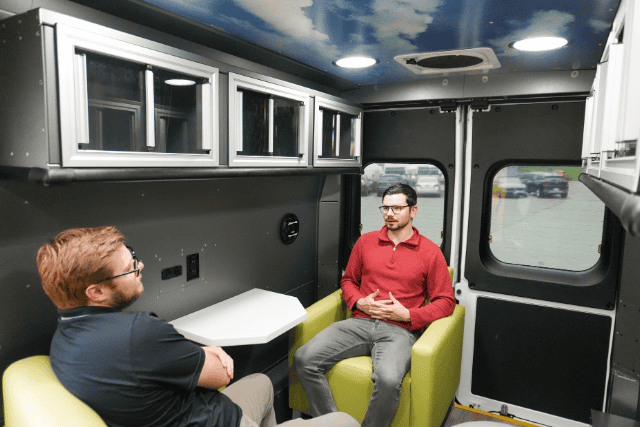
We’ve talked about money, but the cost isn’t the only thing that matters. When trying to determine the best way to serve your community, consider how each option operates in the real world.
Let’s look at a few other big differences between running a Mobile Counselling Van and renting a traditional office space in Ontario.
1. Accessibility: Coming to them vs. waiting for them
This is the heart of the matter. An office lease assumes one big thing: that your clients can get to you.
In downtown Toronto or Ottawa, that might be true. If you’re right next to a subway station or a major bus route, an office can work great. You have foot traffic, and people can pop in on their lunch break. It’s stable, and it’s familiar.
But what about the rest of Ontario?
- The distance decay problem: Research shows that the farther people live from a doctor or therapist, the less likely they are to go. In Northern Ontario, where communities can be hours apart, this is a massive barrier.
- Transportation is a privilege: Not everyone has a reliable car or money for gas. Public transit in rural areas is often non-existent. If a client is struggling with severe anxiety or depression, the stress of finding a ride can be enough to make them cancel.
- Leaving people behind: If you’re fixed in one spot, you’re unintentionally leaving out the people who need you most: those without the means to travel.
With a Mobile Counselling Van, you flip the script. You go where the need is, can park at a community center in Thunder Bay one day and a remote First Nation community the next. You aren’t waiting for them to overcome barriers; you’re removing the barriers for them.
2. Flexibility vs. stability
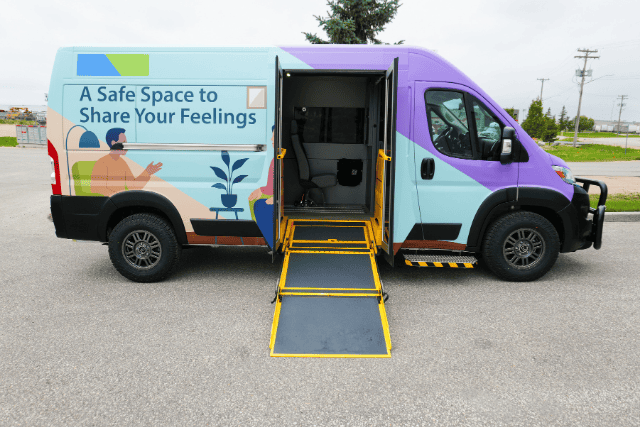
An office gives you stability. You have a permanent address. You can decorate the waiting room with nice plants and have a dedicated staff break room. For clients who need long-term, intensive therapy in a very controlled environment, this consistency can be comforting.
But that stability comes with its own barriers.
- Stuck in a lease: If the demographics of your neighbourhood change, or if a new need pops up three towns over, you can’t just pick up your office and move. You’re locked in for 3, 5, or 10 years.
- One location at a time: You can only be in one place. If there’s a crisis in another community, your team has to scramble to find a temporary space to rent or work out of a car.
A Mobile Counselling Van gives you freedom.
- Disaster response: If a community faces a crisis, like a flood or a tragic event, you can drive your mobile crisis unit right to the scene to offer immediate mental health support.
- Testing new markets: Not sure if a certain town needs your services? You can run a pilot program with the van for a few months without signing a 5-year lease.
3. Privacy and stigma
This is a tricky one, and it works differently for both.
The office lease:
- Pro: It’s anonymous to walk into a large medical building. No one knows if you’re seeing a dentist or a therapist.
- Con: For some, the clinical setting feels cold and intimidating. Walking through a waiting room full of people can be terrifying for someone with social anxiety.
The Mobile Counselling Van:
- Pro: It feels less “medical.” It’s casual. Meeting in a van parked at a familiar community center or a park can feel safer and less formal than a sterile office. It puts the power back in the client’s hands because they are on their own turf.
- Con: If you design your van with mental health services branding all over it, some might be a bit shy if they’re entering it in a very public place. This can be easily mitigated by using subtle branding or partnering with community centers where the van’s presence is normalized.
4. The no-show rate
Every missed appointment is a missed opportunity to help someone. It also costs your organization money.
- Office leases: High no-show rates are common, especially in winter. When a snowstorm hits Highway 11 or the 401, people cancel. When a car breaks down, they cancel.
- Mobile Counselling Vans: You dramatically cut down on no-shows because you are right there. You eliminate the travel friction. If it’s snowing, you’re likely already parked in their community, so they only have to walk down the street, not drive 45 minutes on icy roads.
| Fonctionnalité | Office lease | Camion de conseil mobile |
| Situation géographique | Fixed (Clients come to you) | Flexible (You go to clients) |
| Reach | Limited to local radius | Unlimited (Anywhere with a road) |
| Commitment | Long-term lease contracts | One-time purchase (Asset owned) |
| Meilleur pour | High-density urban areas | Rural, remote, or underserved areas |
| Barrier removal | Low (Relies on client travel) | High (Removes travel need) |
At the end of the day, an office is great for stability, but a Mobile Counselling Van is built for connection. It’s about deciding whether you want to be a destination people have to find, or a solution that finds them.
Mobile Counselling Van vs. office lease: Which option should you choose?
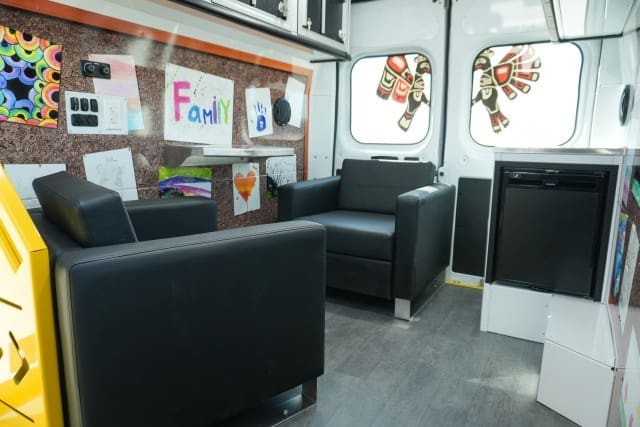
Choosing between a permanent office and a mobile unit is a big decision. It shapes how your team works and how people receive care. There isn’t a single correct answer for everyone. A busy practice in downtown Toronto might thrive with a lease. But for many organizations, the freedom to move is hard to beat.
Here are five things you should think about before you sign on the dotted line.
1. Who are you trying to reach?
Think about the people you serve. Are they office workers in a city who can pop in during lunch? Or are they seniors, youth in remote areas, or people with mobility challenges?
If your clients struggle to leave their homes or live in communities with poor transit, asking them to come to an office might be a barrier they can’t overcome. Mobile Counselling Vans let you meet them where they are. There’s something really powerful about showing up in someone’s driveway or local park. It tells them, “You matter enough for us to come to you.”
2. How does your funding work?
Money talks. In the non-profit and healthcare world, funding cycles can be tricky.
- For leases: Grants might cover operating costs, but rent is money that leaves your bank account forever.
- For vans: Many capital grants and donors prefer to fund tangible assets. It’s often easier to get funding for a vehicle that the community can see and touch than it is to get funding for 5 years of rent. Plus, once you buy a Mobile Counselling Van, you own it. It’s an asset on your books, not an expense.
3. What does your map look like?
Ontario is huge. If your mandate covers a specific neighbourhood, an office makes sense. However, if you’re responsible for a large region, such as a county or a sprawling rural municipality, a single office creates a limited radius of care. People outside that radius often get left behind.
Mobile therapy allows you to shrink the map. You can serve Town A on Mondays and Town B on Tuesdays. You can cover more ground without incurring the costs of multiple building leases.
4. How fast do you need to launch?
Renovating an office space can take months. You have to deal with permits, contractors, and inspections. It can be a headache.
While building a custom van takes time, too, it’s often a smoother process because we handle it all in-house. Once the keys are in your hand, you are ready to work immediately. There’s no waiting for the paint to dry or the internet to be hooked up. You just turn the key and go.
5. What is your long-term vision?
Where do you see your organization in 10 years?
- The office path: You are planting deep roots in one spot. This is great for stability, but it can be hard to change if your neighbourhood changes.
- The mobile path: You are building a program that can adapt. If the needs of the community shift, you shift with them. You aren’t tied down.
Improve Ontario mental health services: Let’s talk today

You likely came to this article because you’re feeling a bit stuck. Maybe you’re worried about reaching people in remote communities who can’t get to you, or you’re stressed about the high cost of rent eating up your budget.
Now you know that while offices offer stability, Mobile Counselling Vans give you the freedom to reach more people for less money over time.
- You learned the real cost difference between renting an office and owning a van.
- You discovered how mobile units remove barriers for people who can’t travel.
- You saw why flexibility is the key to saving more lives in Ontario.
Au MoveMobility, we believe that healthcare should never be out of reach. We work side-by-side with teams like yours to design vehicles that feel less like a clinic and more like a safe haven. It’s our privilege to support the incredible work you do every single day.
Si vous avez des questions, cliquez sur le bouton ci-dessous pour discuter avec un expert en mobilité.
If you aren’t quite ready to chat with a mobility expert, we have a few other articles that might help you decide.
- Mobile mental health clinics: Everything you need to know: Read this to get a deep dive into how mobile mental health clinics operate and the impact they have on patient care.
- Quel est le coût d'une camionnette médicale mobile ?? If the budget is your biggest question, this article breaks down the numbers so you can plan ahead.

 English
 French